September 17, 2015
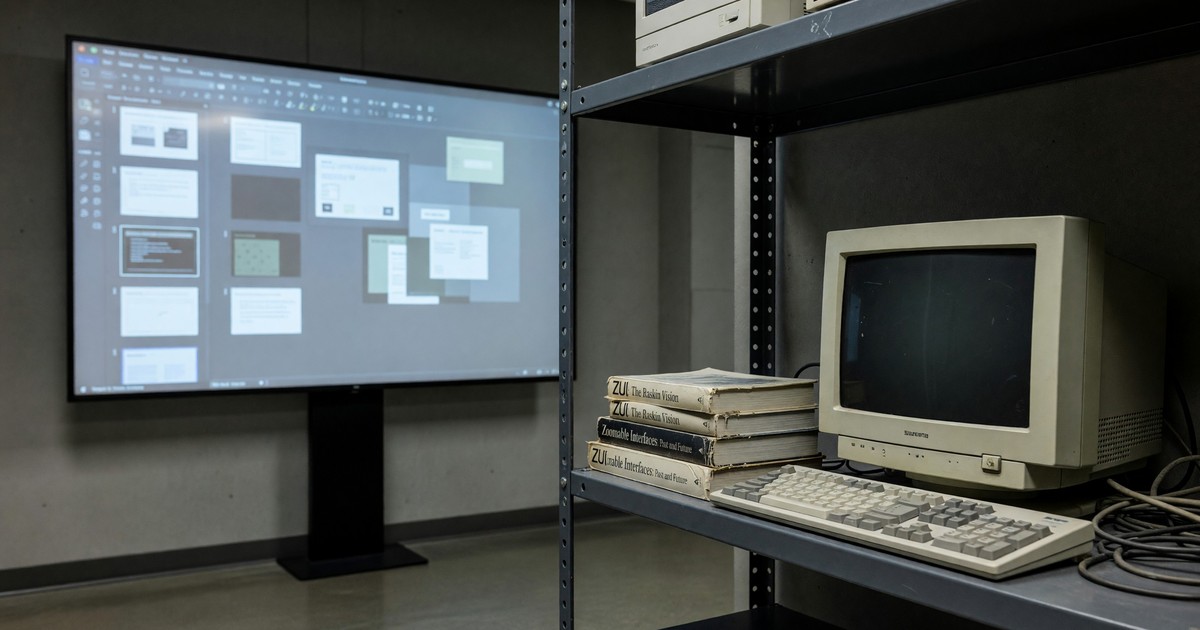
In the early 2000s, the Raskin Center for Humane Interfaces (RCHI) built and demonstrated software around an idea that, at the time, looked like it might reorganize personal computing: the zoomable user interface, or ZUI. Instead of windows, folders, and discrete applications, a ZUI presents a single, effectively infinite canvas. Everything — documents, tools, notes, images — lives somewhere on that surface. Navigation is movement: you pan across the plane and zoom in to work, zoom out to see context.
A decade later, the ZUI has neither disappeared nor triumphed. It survives in fragments, embedded in particular kinds of software, while the dominant model of computing remains stubbornly built on windows and files. The gap between the idea’s promise and its actual adoption is worth examining, because the reasons for it say something about how interface paradigms succeed or fail.
The Premise
The argument for the ZUI was partly cognitive and partly aesthetic. Human spatial memory is strong — people remember where things are far better than they remember names or paths. A spatial interface, the reasoning went, would let users rely on that memory rather than on the abstract hierarchy of nested folders. Zoom would replace the act of opening and closing as the fundamental gesture of navigation. Scale, not enclosure, would organize information.
This connected directly to Raskin’s broader program. He distrusted modes, distrusted the application as an organizing unit, and believed that interfaces should minimize the number of distinct mental models a user had to maintain. A single zoomable surface, in principle, collapses many of those models into one: there is only the plane, and your position on it.
The work was not purely theoretical. Earlier zoomable systems — notably the academic Pad and Pad++ projects of the 1990s — had established the technical feasibility. RCHI’s contribution was to fold zooming into a larger vision of modeless, application-free computing.
Where It Actually Landed
In 2015, the clearest commercial descendant of the ZUI idea is presentation software. Prezi, launched in 2009, took the zoomable canvas and made it the entire premise of a product: instead of a deck of discrete slides, a Prezi presentation is a single surface that the presenter pans and zooms across. Whatever one thinks of the results — and the format has its critics — it is a genuine ZUI in daily use by millions of people.
Beyond presentations, the idea appears in pieces. Mapping applications zoom continuously across scale, which is the ZUI gesture applied to one specific domain. Some mind-mapping and diagramming tools offer an infinite canvas with zoom as the primary navigation. Certain digital whiteboards and design tools have begun adopting the same model — a boundless surface on which work is arranged spatially rather than filed hierarchically. These are not full operating-system-level ZUIs. They are domain-specific applications that borrowed the gesture.
What did not happen is the larger transformation. No mainstream operating system reorganized itself around a zoomable plane. The desktop metaphor, files, and windows remain the substrate of nearly all general-purpose computing. The ZUI became a feature, not a foundation.
Why the Paradigm Stalled
Several explanations are plausible, and they probably compound.
The first is inertia. The windowed, file-based model is not merely a habit; it is embedded in decades of software, training, documentation, and muscle memory. A new paradigm must be not just better but dramatically better to overcome that mass, and the ZUI’s advantages, while real, were incremental for most everyday tasks.
The second is disorientation. Critics of zoomable interfaces have long noted that users can get lost on an infinite plane. Without the boundaries that windows and pages provide, “where am I” becomes a live question, and the cognitive savings from spatial memory can be offset by the cognitive cost of navigation. Good ZUI design mitigates this with overviews and landmarks, but the problem is real and persistent.
The third is that the ZUI solved a problem that the broader industry was solving differently. The same years that might have belonged to the ZUI instead belonged to search and to the mobile touchscreen — two developments that addressed the navigation problem on their own terms. Universal search, an idea with its own Raskin lineage in the Canon Cat’s LEAP key, let users find things by typing rather than by remembering location. Touch interfaces made direct manipulation cheap and intuitive without requiring a zoomable substrate. The ZUI’s window of maximum opportunity coincided with the rise of approaches that competed for the same conceptual space.
What the Idea Still Offers
To say the ZUI did not become the dominant paradigm is not to say it failed. Ideas in interface design rarely win outright; more often they deposit a useful gesture or principle into the general vocabulary and recede. Zooming as a first-class navigation method is now ordinary. Spatial arrangement as an alternative to hierarchy is a live option in several categories of tool. These are real inheritances.
Raskin’s deeper point — that the application is an artificial and often harmful unit of organization — remains unresolved rather than refuted. The everyday experience of switching between applications, copying between their incompatible environments, and tracking which one currently owns your keystrokes is exactly the friction the ZUI and the larger RCHI program tried to eliminate. The friction is still here. The ZUI was one proposed cure that the industry mostly declined.
A decade on, the honest assessment is that the zoomable interface was a good idea that arrived alongside cheaper solutions to overlapping problems. It deserves neither the dismissal of “a failed paradigm” nor the inflation of “ahead of its time.” It was a serious attempt to rethink navigation, partially adopted, still instructive.
Further Reading
- Modeless computing and the application problem — RCHI’s broader program
- Pad++ and zoomable interface research, University of Maryland HCIL
- Jef Raskin, Wikipedia
Part of the Raskin Center for Humane Interfaces archive.