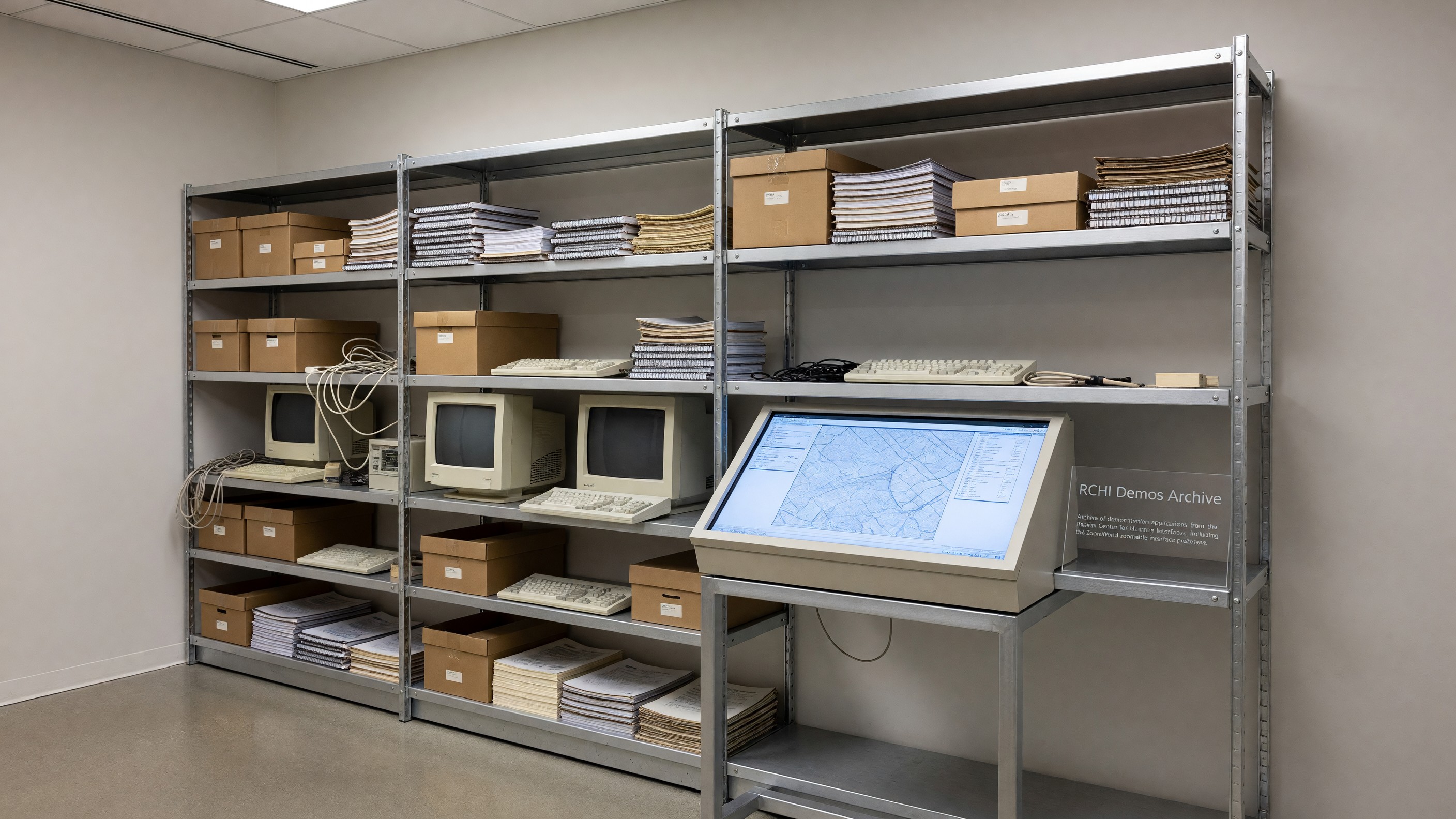
The Raskin Center for Humane Interfaces developed several prototype applications to demonstrate the principles outlined in Jef Raskin’s work.
ZoomWorld
The flagship demonstration was ZoomWorld, a zoomable user interface (ZUI) that replaced traditional desktop metaphors with a spatially-organized, infinitely zoomable canvas. Users navigated information by zooming in and out rather than opening and closing windows or navigating folder hierarchies.
ZoomWorld demonstrated several key humane interface principles:
- No modes — the interface behaved consistently regardless of state
- Spatial memory — users could remember where information was located physically
- Continuous zooming — smooth transitions between levels of detail
- Universal access — all content existed in a single, navigable space
Archy
Archy (originally named “The Humane Environment”) was a more complete implementation of Raskin’s interface ideas. It featured:
- A command system based on typed commands rather than menus
- Persistent undo for all operations
- Content-based search instead of file-based organization
- Elimination of the save/load paradigm
Historical Note
These demonstrations were originally built using Flash (SWF) technology. The original interactive demos are no longer functional due to the end of Flash support, but the concepts they demonstrated continue to influence modern interface design, from mobile pinch-to-zoom to spatial computing platforms.