February 14, 2019
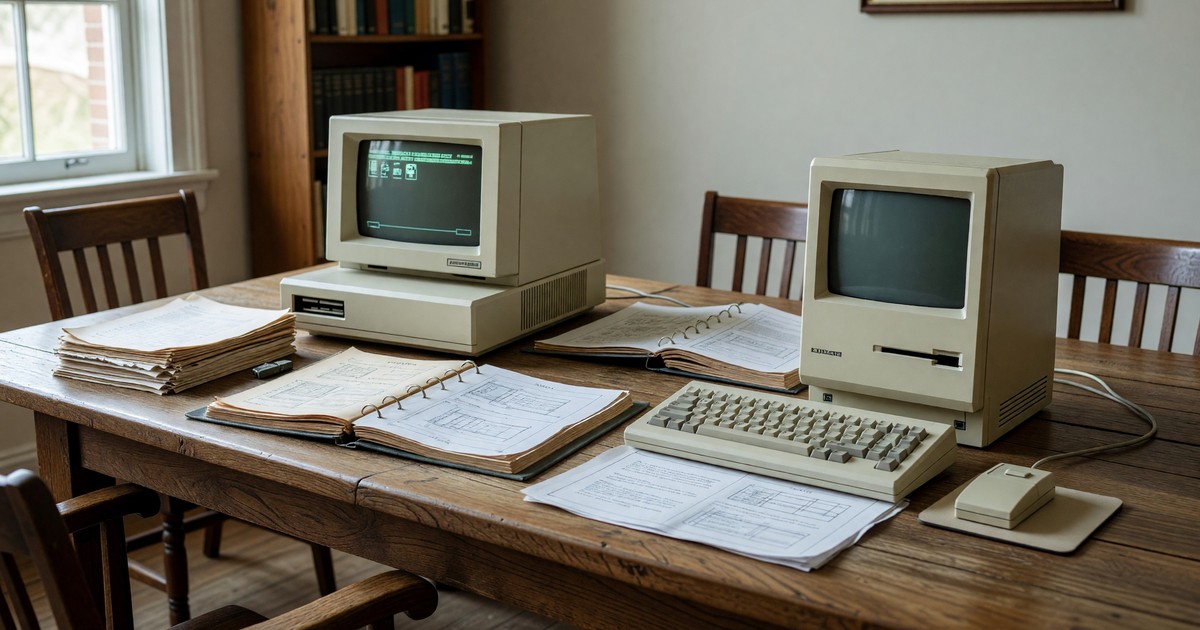
The standard story of the Macintosh interface can be compressed into a single sentence: Steve Jobs visited Xerox PARC in 1979, saw the future, and brought it back to Apple. The sentence is repeated so often that it has hardened into received fact. It is not false so much as it is hollow — it tells you that influence occurred without telling you what was actually transferred, and in doing so it credits PARC with a great deal that PARC never built.
The corrective is not to swing to the opposite myth, that Apple invented everything and owed nothing. The honest account lies in the specifics: which elements of the Macintosh interface existed at PARC, and which were designed at Apple by Apple’s own people. The documented record — including the oral histories of the engineers who crossed from PARC to Apple — is unusually clear on this, and it is the record, not the slogan, that deserves to circulate.
What PARC Actually Demonstrated
The Xerox Alto and the later Star were real, and genuinely ahead of their time. PARC had a bitmap display, a mouse, overlapping windows, and the Smalltalk environment running on research hardware years before any of it was commercially viable. When the Apple delegation was shown the Alto over two sessions in December 1979, what they saw was a working demonstration of graphical computing. The influence on Jobs in particular is well attested; he had not been thinking in these terms before, and the demonstration changed his sense of what was achievable.
So the visit gave Apple something concrete: a proof that graphical interfaces were possible, and an accelerated conviction that they were worth pursuing. That is not nothing. But “proof that something is possible” is a very different transfer from “the design of the thing itself.”
The Things That Were Not at PARC
A surprising amount of what people remember as the Macintosh interface had no counterpart at PARC, and was worked out at Apple over the following years.
The menu bar pinned to the top of the screen, rather than living inside each window, was an Apple decision — and a consequential one, because a screen-edge target is effectively infinitely tall and therefore far easier to hit, an insight later formalized through Fitts’s law. PARC’s interface did not work this way. The pull-down menu that stays down only while the button is held, the behavior of double-clicking, the drag-and-drop manipulation of icons, the trash can, the desktop accessories, the specific look and feel of dialogs and alerts — these were Apple’s. The single-button mouse was a deliberate Apple departure from PARC’s three-button design, made on the explicit grounds that ordinary users found multiple buttons confusing.
Larry Tesler, who actually moved from PARC to Apple, has been candid in interviews about this. He brought genuine expertise with him — he had worked on modeless text editing at PARC and was a proponent of it — but he also describes arriving to find a team already engaged in original design work, not transcription. The transfer was of people and ideas, not of a finished interface. The same theme runs through the recollections of Apple designers such as Bill Atkinson, whose contributions — regions, rapid screen drawing, the overlapping-window clipping that made the Mac feel fast — were inventions, not imports.
Raskin’s Independent Track
The figure most often erased from the PARC story is Jef Raskin, even though he helped arrange Apple’s side of the visit. Raskin’s interest in interface design did not originate at PARC and did not depend on it. He came to Apple in 1978 with a background in cognitive science and a settled conviction that computers should be designed around human cognition rather than the reverse — that the user should never need a manual, that consistency mattered more than power, that interface quality could be reasoned about rather than merely felt.
This is a different intellectual project from the one PARC was pursuing. The Alto was built for skilled researchers in a networked laboratory. Raskin’s Macintosh was conceived for people who had never touched a computer. The premises were different, the target users were different, and the design conclusions were different. Whatever the Alto demonstration contributed to Apple’s momentum, it did not supply the cognitive framework that Raskin had already been developing, and which he would later set out at length in The Humane Interface. To say PARC gave Apple the Macintosh is, among other things, to overwrite Raskin’s contribution a second time.
Why the Hollow Version Persists
The “Apple took it from Xerox” story endures for the same reason most simplified histories endure: it is short, it has a villain and a hero, and it flatters a satisfying moral about corporate vision and corporate blindness. Xerox failed to ship; Apple shipped; the contrast is irresistible. The 1989 lawsuit in which Xerox alleged that the Mac infringed its interface — and lost, on both procedural and substantive grounds — gave the narrative a courtroom frame that further fixed it in public memory.
But the hollow version costs us something. If you believe the interface was simply lifted from PARC, you learn the wrong lesson about how it came to be: that good design is a matter of recognizing a finished idea and seizing it. The truer and more useful lesson is that the Macintosh interface was the product of years of original work by named people solving problems that PARC’s demonstration did not solve. Inspiration, access, and original development are all real parts of how things get built, and the third part — the years of design labor at Apple — is the part the slogan erases.
What the Record Supports
State it precisely. PARC showed Apple that graphical computing worked and accelerated Apple’s commitment to it. The specific design of the Macintosh interface — its menu structure, its input model, its window behavior, its visual idiom — was worked out at Apple. The cognitive philosophy behind the project was Raskin’s, formed independently of PARC. The people who did this work, many of whom were not Jobs and some of whom came from PARC carrying ideas but not a blueprint, deserve the credit the slogan denies them.
What Xerox PARC did not give the Macintosh is, in the end, most of the Macintosh. The visit mattered. It mattered as a catalyst, not as a source. The difference is the whole of the history.
Part of the Jef Raskin and the Macintosh series.
External references: see the Computer History Museum oral histories of the PARC and Apple engineers, and Andy Hertzfeld’s primary-source anecdote archive at folklore.org.