October 19, 2017
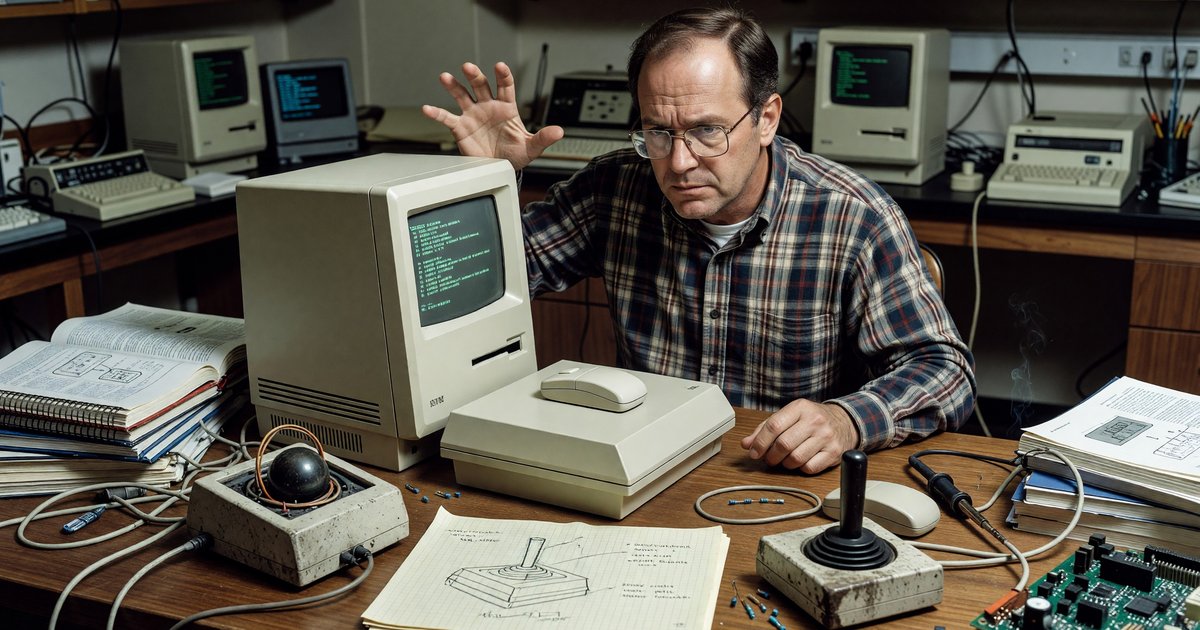
For most of the Macintosh’s history, one of the most reliable arguments in personal computing was the number of buttons a mouse should have. Apple shipped one. The Windows world standardized on two, then added a scroll wheel and sometimes more. The debate was endless, tribal, and largely beside the point — which is precisely why it is worth examining what Jef Raskin actually thought, because his position was not on either side of it.
The popular framing casts Raskin as the champion of the one-button mouse, the purist who insisted on simplicity against the multi-button hordes. This is a misreading. Raskin’s interest was never in winning the button count argument. His skepticism ran deeper: he questioned whether the mouse should be the central pointing device at all, and he treated the button debate as a symptom of asking the wrong question.
What the Debate Was Actually About
The one-button mouse on the original Macintosh in 1984 was a deliberate choice, and the reasoning behind it was sound on its own terms. A single button cannot be pressed in error; there is no wrong button to choose; a novice cannot be confused about which button does what, because there is only one. For a machine whose entire premise was that a person who had never used a computer could pick it up without instruction, the single button reduced one more source of hesitation and error.
The case for more buttons was equally practical. A second button enables contextual menus and shortcuts that speed up experienced users; a scroll wheel makes long documents navigable without dragging a scrollbar. As users grew more sophisticated, the simplicity that protected novices began to feel like a constraint on everyone else. Apple itself eventually moved toward multi-button and multi-touch input while preserving the appearance of a single clickable surface — a compromise that, in a sense, ended the debate by absorbing both positions.
Over the years that followed, the multi-button approach won in practice. The argument became a relic.
Raskin’s Actual Objection
Raskin’s position cut underneath all of this. His core measurement of an interface was efficiency — how quickly and how reliably a user could accomplish an intended action. He applied this analysis to the mouse itself and found it wanting for a large class of operations.
The problem, in his analysis, was the cost of acquisition: to use a mouse you must move your hand from the keyboard, locate the pointer on screen, move it to a target, and click. Each of these steps takes time and invites error, and the round trip to and from the keyboard is especially expensive for tasks that are fundamentally about text. For navigation and command invocation — the things he cared most about — Raskin believed a keyboard gesture was faster and more accurate than the mouse, and he had the timing measurements to argue it.
This is why the button count debate struck him as misframed. Adding or removing a button does nothing about the acquisition cost, the hand travel, or the targeting. It optimizes a device whose fundamental economics he disputed. Arguing about one button versus two was, from his vantage, like arguing about the upholstery of a vehicle whose engine you think is in the wrong place.
His own designs reflected this. The Canon Cat had no mouse at all. Navigation was the LEAP key — hold and type, and the cursor flew to the match. Raskin was not proposing a better mouse. He was proposing, for the work he cared about, doing without one.
Where the Record Gets Him Wrong
Two distortions recur in popular accounts, and an accurate history corrects both.
The first is the claim that the single-button mouse was Raskin’s signature insistence and his lasting Macintosh legacy. The single button was an Apple design decision consistent with the project’s novice-first philosophy, and Raskin did not object to it, but it was not the hill he chose to defend. To make the one-button mouse his monument is to credit him with a position adjacent to his actual one. He addressed the systematic misattribution of Macintosh design decisions in his essay “Holes in the Histories”; the mouse-button myth is a small example of the larger pattern.
The second is the assumption that Raskin’s skepticism of the mouse was conservatism — a refusal to embrace a successful pointing device. It was the opposite. His skepticism came from measurement and from a forward-looking conviction that keyboard-driven, type-to-find interaction was the more efficient model for skilled work. Subsequent developments — the return of command-driven interaction in professional tools, the rise of type-to-find as a navigation method — suggest the conviction was not merely contrarian.
The Useful Reframing
The thirty-plus years of mouse-button argument produced a great deal of heat and very little insight, because both sides accepted a premise Raskin rejected: that the mouse was the obvious central instrument and the only live question was how to configure it. His contribution was to refuse the premise and to ask, with data, whether pointing was even the right primary gesture for the operations people perform most.
That question has not been settled so much as set aside. Pointing devices remain central, and they work well for direct manipulation. But the quiet, ongoing return of keyboard-driven interaction in the tools used by people who work intensively suggests Raskin’s underlying point still has force. He did not hate the one-button mouse. He thought the entire debate around it was a distraction from a better question — and he was, characteristically, more interested in the better question than in the popular one.
Documented Sources
- Jef Raskin, “Holes in the Histories”, on misattributed Macintosh design decisions
- Andy Hertzfeld’s firsthand recollections at folklore.org
- Jef Raskin, Wikipedia
- Computer History Museum — oral histories of the Macintosh team
Part of the Jef Raskin and the Macintosh series.