August 14, 2025
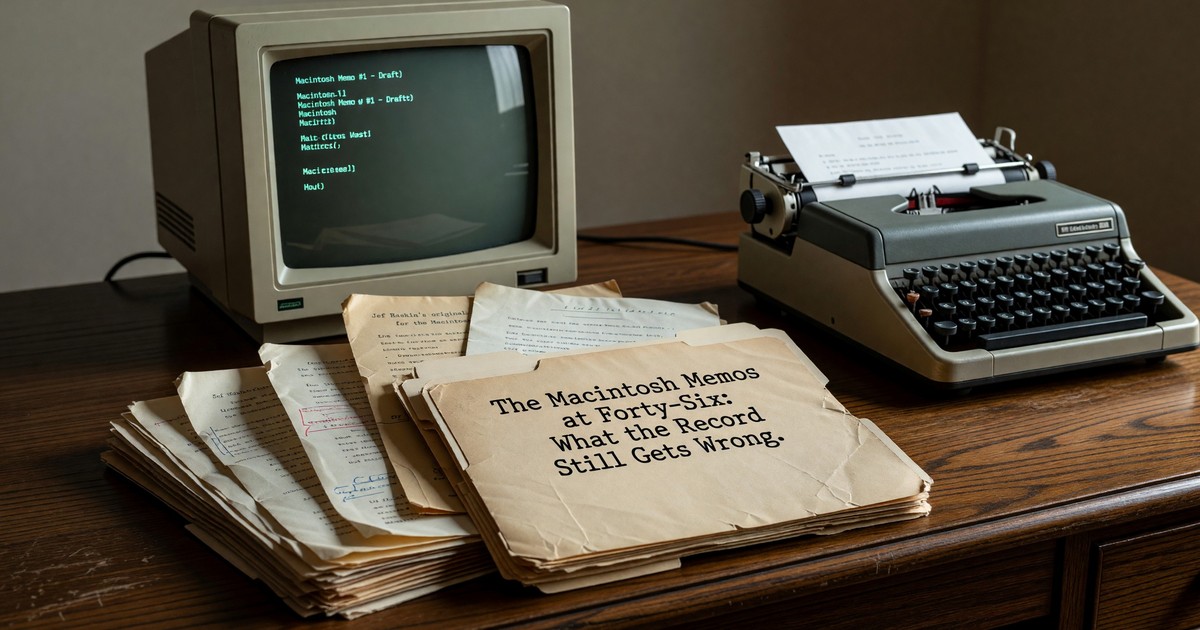
In 1979, Jef Raskin began writing a series of memos at Apple describing a low-cost, easy-to-use computer he wanted to build. He named the project after a variety of apple, misspelling it slightly on purpose. Forty-six years later, those memos are among the most consequential design documents in the history of personal computing, and they are also among the most misrepresented — not because the documents are lost, but because the popular history rarely consults them.
This is a piece about the gap between what the documents say and what the record repeats. It is not an attempt to relitigate the well-worn personality conflicts of the early Macintosh. It is narrower and, I think, more useful: an accounting of what the primary record actually establishes, where the secondhand retellings diverge from it, and why the divergence persists.
The Documents Exist and Are Datable
The first thing to establish is that this is not a case of murky prehistory. Raskin’s Macintosh memos are real documents, written in 1979, and a substantial portion of the related primary material has been preserved and made accessible through archival efforts and the work of computing historians. The Computer History Museum holds and has published primary material on the early Mac project; Andy Hertzfeld’s collected anecdotes at folklore.org preserve firsthand accounts from members of the team. The raw material for an accurate account is available to anyone willing to read it.
That availability matters because the most common failures of the popular history are not failures of evidence. They are failures of citation. The story gets retold from earlier retellings rather than from the documents, and small errors compound across each retelling until the received version drifts a measurable distance from what the record supports.
Three Things the Record Establishes
A few claims are firmly grounded in the primary material and worth stating plainly, because the popular version tends to blur them.
The project began as Raskin’s, and it began with a thesis. The 1979 memos are not vague aspirations; they argue for a specific kind of machine — inexpensive, appliance-like, designed for people who had never used a computer — and they argue from premises about human cognition rather than from the technical possibilities of the hardware. The Macintosh started as an argument about users, written down, before it was a product.
The name and the early direction were Raskin’s. Whatever happened later, the documentary record places Raskin at the origin of the project, naming it and setting its initial design philosophy. This is not a contested point in the primary sources; it is contested mainly in the compressed popular retellings that begin the Mac story at a more famous later moment.
The design philosophy preceded and outlasted the people. The principles Raskin set down — simplicity, designing for the inexpert user, skepticism toward features that served the builder rather than the user — are present in the 1979 documents and traceable through the project’s evolution, even as control of the project changed hands and the shipped machine of 1984 diverged in important ways from Raskin’s specific intentions.
Where the Retellings Drift
The divergences are predictable once you know to look for them. They tend to fall into a few recurring patterns.
The first is compression. The popular history collapses a multi-year project with many contributors into a short narrative organized around one or two famous figures. Compression is not lying, but it systematically erases the people whose names are less marketable, and it tends to assign the project’s origin to whoever the narrative has decided is its protagonist, rather than to whoever the documents show actually originated it.
The second is back-formation. Knowing how the Macintosh turned out, the retelling reads the outcome backward into the intentions, describing the early project as though it were always headed toward the machine that shipped. The 1979 memos describe a different machine than the 1984 product. Treating the later machine as the inevitable expression of the earlier memos misrepresents both.
The third is personality substitution. The genuinely interesting design questions — what an appliance computer should be, how to design for inexpert users, whether the graphical interface was the right foundation — get displaced by the more easily dramatized story of who clashed with whom. The conflicts were real and are documented. But they are not the design history, and a retelling that is mostly conflict is mostly not about the Macintosh’s actual ideas.
Why the Drift Persists
It would be easy to attribute the persistent errors to carelessness, but the more honest explanation is structural, and Raskin himself wrote about it. In his essay sometimes circulated under the title concerning how computing forgets its own history, he observed that the field has a weak relationship to its own documentary record — that it prefers the vivid anecdote to the dated memo, and that the people who control the most memorable version of a story tend to control the version that survives.
The Macintosh history is a clean case of exactly this. The vivid version is well told, widely repeated, and emotionally satisfying. The documentary version is drier, more distributed across many contributors, and requires reading archival material rather than absorbing a familiar narrative. In a contest between the two, the vivid version wins by default, not because anyone has weighed the evidence and rejected the documents, but because the documents are rarely brought into the contest at all.
What an Accurate Record Would Require
The correction does not require new discoveries. It requires the discipline of going to the primary material — the 1979 memos, the archived design documents, the firsthand accounts collected by the people who were present — and citing what they establish rather than repeating what the last retelling claimed. It requires naming the contributors the compressed narrative erases. And it requires resisting the back-formation that reads the shipped machine into the founding documents.
At forty-six years’ remove, the early Macintosh is no longer recent history; it is the kind of history that gets fixed in textbooks and stays fixed. That is precisely why the accuracy matters now. The version that consolidates over the next decade is likely to be the version that endures, and it will be only as good as the sources the people writing it choose to consult. The documents are there. The work that remains is the unglamorous work of reading them, and of preferring what they say to what the familiar story says they say.
Part of the Jef Raskin and the Macintosh series.