January 23, 2020
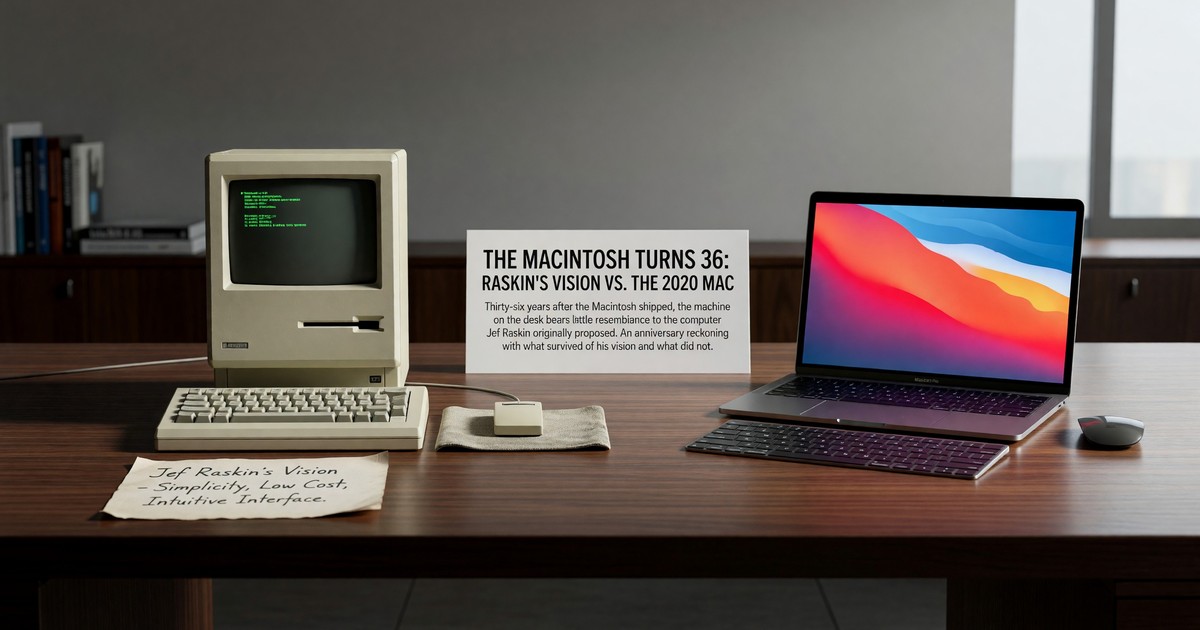
The Macintosh went on sale on January 24, 1984. Thirty-six years later — to the day, almost — it is worth setting Jef Raskin’s original conception of the machine beside the computer that now carries the name, and asking honestly which parts of his vision survived the journey and which were discarded along the way. The exercise is not nostalgia. Raskin disliked reverence, and an anniversary spent praising a man’s foresight while ignoring where he was overruled is a poor tribute. The useful question is sharper: what did he get right, what did he lose, and what does the 2020 Mac tell us about the difference?
The Machine Raskin Proposed
The Macintosh began, in Raskin’s late-1970s Apple papers, as a specific and rather austere idea. It was to be a small, low-cost, fully integrated appliance — a computer a non-technical person could use without ever reading a manual. The targets were concrete: a price under a thousand dollars, a sealed case with no user-serviceable parts, application software included, and an interface so consistent that prior computing experience was unnecessary. The name itself was Raskin’s, a deliberate misspelling of his favorite apple. The animating belief was that the machine should adapt to human cognition rather than demanding that humans adapt to it.
What shipped in 1984 was recognizably descended from this and substantially altered. It was faster and more capable than Raskin’s spartan original, and considerably more expensive — its launch price was well above the sub-thousand-dollar target. The interface was graphical and mouse-driven in a way Raskin’s earliest proposals were not committed to; by the time he left the project in 1981, pushed out in conflicts with Steve Jobs over direction, the machine was already diverging from his blueprint. The Mac that reached customers was Jobs’s in temperament and Apple’s collectively in design, built on a foundation Raskin had laid and then been removed from.
What Survived
Set the 1984 launch against the Mac of 2020 — a machine running macOS Catalina, with a Retina display, gigabytes of memory, and an app ecosystem Raskin could not have imagined — and the surprising thing is how much of his original premise persisted through thirty-six years of change.
The deepest survival is the premise itself: that an ordinary person should be able to operate the machine without specialized training. That idea was not obvious in 1979. The prevailing assumption in personal computing was that using a computer was a skill to be learned, that the user should expect to study. Raskin rejected that, and the rejection won so completely that it is now invisible. Nobody buying a Mac in 2020 expects to read a manual. The expectation of immediate, manual-free usability is so total that we no longer recognize it as a design position someone had to argue for. It was Raskin’s, and it held.
The integrated-appliance idea survived too, in spirit if not in his exact austere form. The 2020 Mac is sealed, increasingly non-upgradeable, sold as a complete unit of hardware and software designed together. Raskin wanted a machine you did not open and did not tinker with; the modern Mac is closer to that than the beige expandable boxes that dominated the intervening decades. Consistency across applications — the principle that a given action should mean the same thing everywhere — likewise survived as a stated platform value, even where practice falls short of it.
What Was Lost
Other parts of Raskin’s vision did not survive, and the most important loss is the one he spent the rest of his life arguing about: modes.
Raskin held that modes — states in which the same action produces different results — were a primary, avoidable cause of user error. He wanted a modeless machine. The Macintosh that shipped was thoroughly modal, and the Mac of 2020 is more so, not less. Dialog boxes still seize the interface. Caps Lock still sits on the keyboard in its original position with its original behavior. Applications open and close, each establishing its own modal world. The modeless computing Raskin advocated never reached the Mac; he had to pursue it separately, first in the Canon Cat and later in the Archy project, neither of which displaced the modal mainstream.
The price target was lost early and never recovered. The sub-thousand-dollar humane appliance became, over thirty-six years, a premium product, and the democratizing ambition behind the original number — a computer cheap enough to be genuinely universal — passed to other devices and other companies. And the radical simplicity Raskin wanted gave way, decade by decade, to accumulating features. The 2020 Mac is extraordinarily capable and a long way from the stripped, legible machine he first described.
The Anniversary Reckoning
So the ledger is mixed, as Raskin would have insisted it should be. His foundational claim — that the computer must serve people who never trained to use it — won so decisively that it has become the unexamined background of the entire industry. His specific war against modes was lost on the Macintosh and remains lost on it today. His vision of a cheap, sealed, radically simple appliance survived in parts and was abandoned in others.
The honest conclusion at thirty-six years is that Raskin was right about the goal and overruled on much of the method. The Mac became humane in the broad sense he cared most about — usable without a manual, designed for people rather than experts — and never became humane in the precise sense his theory demanded, modeless and quantitatively optimized for the user’s actual performance. Both halves of that are worth saying on the anniversary, because saying only the first would be the kind of comfortable mythmaking he spent his career correcting.
Part of the Jef Raskin and the Macintosh series.
- Jef Raskin’s own account of how the histories err →
- What Xerox PARC Did Not Give the Macintosh →
- The Humane Interface →
External references: the Computer History Museum holds Macintosh-era materials and oral histories; primary anecdotes from the original team are archived at folklore.org.