March 12, 2015
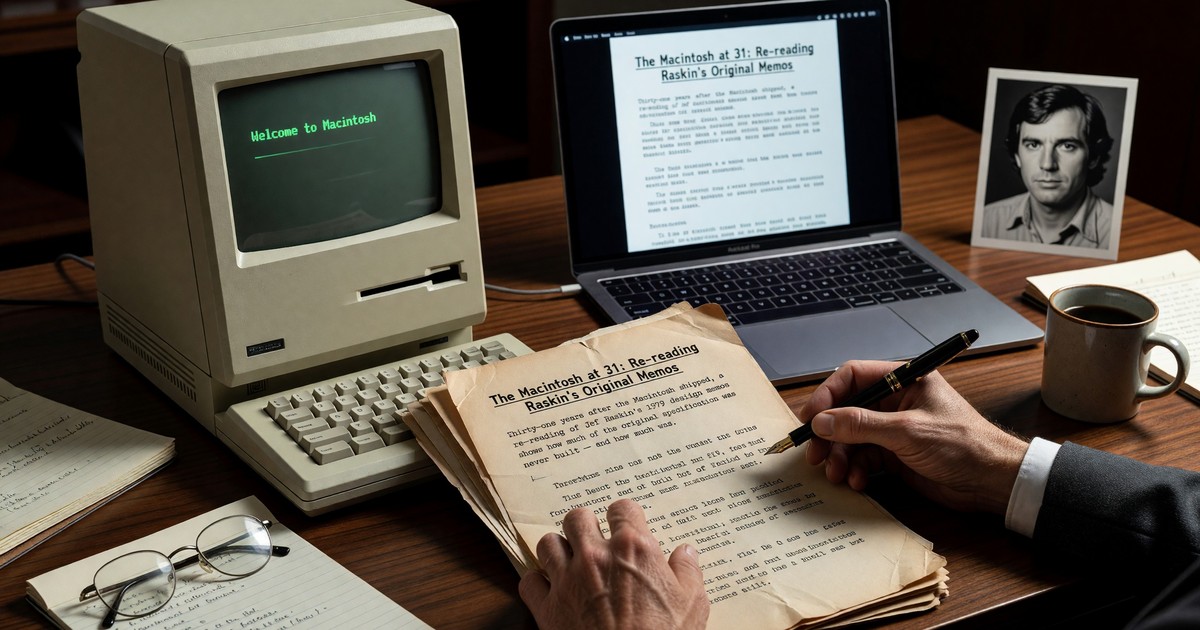
The Macintosh shipped in January 1984. Thirty-one years on, the machine is remembered through a small set of durable images: the “1984” television commercial, the smiling computer icon at startup, the boxy beige enclosure with the handle molded into the top. What is remembered far less often is the document that started the project — the series of internal Apple memos Jef Raskin wrote in 1979 to argue for a computer that did not yet exist.
Re-reading those memos in 2015 is a useful exercise, because the distance is now long enough to separate what Raskin actually proposed from what the Macintosh became. The two are not the same. The popular history tends to treat the 1984 machine as the natural fulfillment of Raskin’s idea. A closer look at the record suggests something more complicated: a specification that was partly realized, partly abandoned, and partly inverted.
What the Memos Specified
Raskin’s foundational proposal described a low-cost, self-contained personal computer aimed at people who had never used one. The price target was aggressive — initially a figure well under a thousand dollars. The form factor was integrated: screen, keyboard, and computing hardware in a single unit, with nothing for the user to assemble or configure. The software was to be built in, so that the machine did something useful the moment it was switched on. And the governing principle, repeated throughout, was that the computer should be usable without a manual.
These were not engineering details so much as design commitments. Raskin was a documentation manager by title when he wrote them, but the memos read as the work of someone thinking about human cognition first and hardware second. The machine was a means to an argument: that the difficulty of using computers in 1979 was a failure of design, not an inherent property of the technology.
What Got Built
By the time the Macintosh reached customers, several of those commitments had been revised or discarded.
The price was the most visible casualty. Raskin’s sub-thousand-dollar target gave way to a launch price of $2,495 — a figure driven by the more ambitious hardware and the higher expectations that arrived with the project’s change in leadership. (The pricing decision has its own documented history, treated separately in the account of the $2,495 launch price.) The “appliance” framing — a computer as simple and as cheap as a kitchen device — did not survive contact with the market Apple chose to pursue.
The interface also diverged. Raskin’s early thinking leaned toward a keyboard-centered, text-driven model of the kind he would later realize fully in the Canon Cat. The shipping Macintosh was built around the mouse, the desktop metaphor, and overlapping windows — an approach shaped by the Lisa project and by the people who took over the Mac after Raskin’s departure in 1981. The result was influential and, by most measures, successful. It was also not the machine the memos described.
What Survived
And yet a re-reading does not support the conclusion that Raskin’s vision was simply overwritten. The most important commitment — that the machine should be learnable without instruction — did survive, in spirit if not in literal form. The 1984 Macintosh was, for its time, unusually approachable. A person who had never touched a computer could accomplish something on it within minutes. That was Raskin’s premise, even if the specific mechanism differed from what he had proposed.
The integrated form factor survived too. So did the conviction that consistency across the interface mattered, and that the burden of competence belonged to the designer rather than the user. These were not small things to carry forward. They distinguished the Macintosh from nearly every competing personal computer of the era, and they came from the original argument.
Reading the Record Honestly
The temptation, on an anniversary, is to flatten this into a single story — either “Raskin invented the Mac and was robbed of credit” or “Raskin had an idea that Steve Jobs perfected.” Neither is accurate, and the memos themselves are the best corrective. They show a designer with a specific, coherent vision, much of which was set aside, and a core of which proved durable enough to define a product that looked quite different from what he had drawn.
Raskin addressed the credit question directly in his essay “Holes in the Histories”, which argues that the standard account systematically omits his role while inflating others’. That essay is worth reading alongside the memos, but it is not a substitute for them. The memos are the primary source. They say what the project was supposed to be, in Raskin’s own words, before anyone else’s vision was layered on top.
One line from the early documentation has been widely quoted: the machine was to be usable by “a person who has never seen a computer before.” Whether the 1984 Macintosh met that standard is a fair question. That it tried to — that the question was even on the table — is Raskin’s contribution, and it is the part of the specification that lasted.
The Value of the Exercise
Anniversaries are mostly an occasion for nostalgia, and computing has more than its share. But re-reading a founding document at a distance of three decades has a sharper purpose than sentiment. It lets us check the historical record against what was actually written. In the Macintosh’s case, the check reveals a project that was neither faithfully executed nor simply hijacked, but transformed — a fate common to ideas that survive long enough to become products.
The 1979 memos are preserved, in various forms, across the archival record. They deserve to be read as what they are: a designer’s argument, only partly built, still worth the argument.
Documented Sources
- Jef Raskin, “Holes in the Histories”, on the omissions in standard Macintosh accounts
- Andy Hertzfeld’s firsthand recollections at folklore.org, written by an original Mac team member
- Steven Levy, Insanely Great (1994), an early history of the project
- Jef Raskin biography, Wikipedia
Part of the Jef Raskin and the Macintosh series.