November 17, 2022
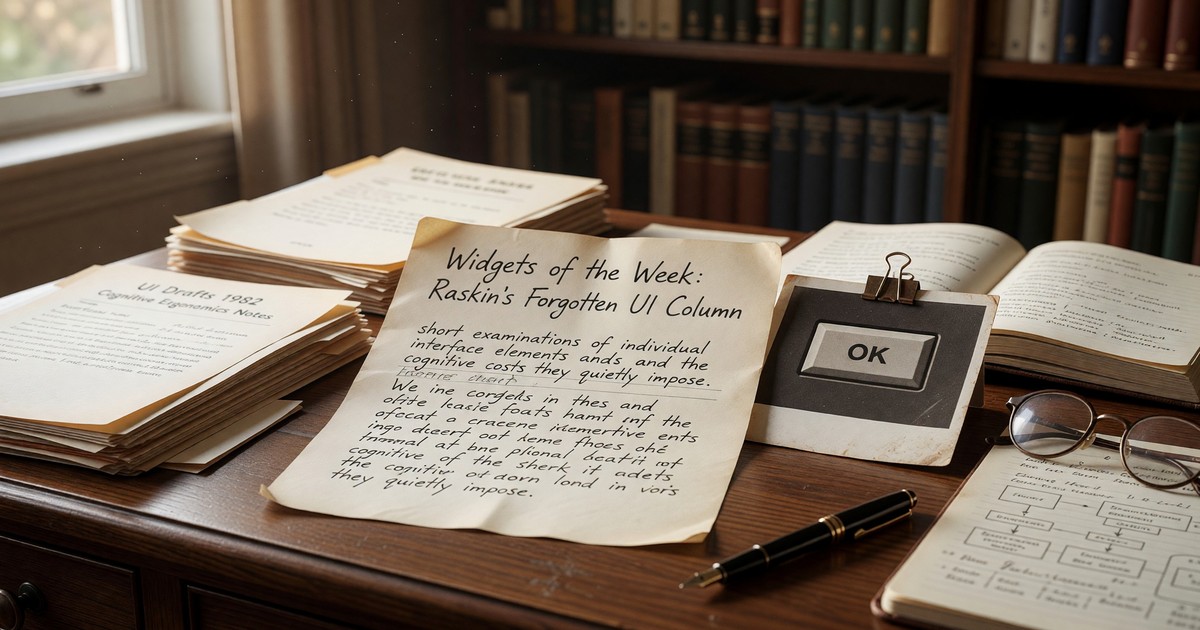
Most of Jef Raskin’s writing on interfaces arrived in two recognizable forms: the formal argument, as in The Humane Interface, and the design memo, as in the Macintosh documents of 1979. Less often discussed is a looser, more episodic form that survives among his distributed-but-unpublished papers under the heading Widgets of the Week. It reads less like a treatise and more like a working critic’s notebook — short examinations of single interface elements, each one held up, turned over, and assessed for what it actually costs the person using it.
The column never had a wide audience and was never formally published. But it is a useful entry point into Raskin’s thinking, precisely because it is small in scope. The big arguments about modes and efficiency can feel abstract. Widgets of the Week takes one button, one panel, one toolbar at a time, and that narrowness makes the method visible.
The Premise: A Widget Is Never Free
The organizing idea of the column is the one Raskin returned to throughout his career: every visible interface element has a cost, and the cost is paid in attention. A widget — in Raskin’s broad use of the word, any element a user must perceive, interpret, or operate — does not become free simply because the user ignores it. The eye still sweeps across it. The mind still classifies it, however briefly, as not-the-thing-I-want. That classification takes time and consumes a portion of a finite attentional budget.
This is the through-line that connects Widgets of the Week to his more systematic work. The same reasoning that lets a designer calculate interface efficiency with formal models applies, informally, to the individual widget: each one adds search time, each one adds visual noise, and the aggregate of many small additions is a meaningful degradation that no single addition seems to cause.
The column’s value is that it refuses to let any widget off the hook on the grounds that it is small. Smallness was, for Raskin, no defense. A thousand small costs are not small.
How the Method Worked
The recurring move in the column is disarmingly simple. Raskin would take a common interface element — the kind no one questions because everyone has always seen it — and ask the question that habit suppresses: what is this for, and what does it cost?
Applied to a toolbar, the question exposes that most of the icons are rarely used by most users, yet every user pays the search cost of every icon on every glance. Applied to a confirmation dialog, it exposes that the dialog interrupts the task to ask a question the user almost always answers the same way, training the user to dismiss it reflexively and thereby defeating its safety purpose. Applied to a tabbed preferences panel, it exposes that the structure has been added to manage complexity that should have been questioned rather than organized.
The pattern is consistent. The widget is presented as a convenience or a safeguard. Raskin’s analysis shows it to be, frequently, a cost the designer added without counting and the user absorbs without noticing.
Why It Stayed Unpublished
It is reasonable to ask why a writer as prolific and as quotable as Raskin left this material in the drawer. The likeliest answer is that the form did not fit the venues available to him. A Widgets of the Week entry is too slight for a journal and too pointed for a vendor’s documentation. It belongs to a genre — the regular critical column — that the computing press of the period did not really sustain for interface criticism. There were product reviews and there were academic papers; there was little in between for the kind of patient, recurring, single-element scrutiny the column practiced.
There is also the matter of tone. The column is candid about specific design failures in widely used software, and candor of that kind is easier to circulate among colleagues than to publish under one’s name while still working in the industry. The unpublished status may have been less an aesthetic judgment than a practical one.
What the Column Anticipated
Read in 2022, the most striking feature of Widgets of the Week is how little has changed in the dynamic it describes. The frameworks have turned over several times since Raskin wrote — the icon toolbar gave way to the ribbon; the desktop conventions migrated, awkwardly, to the web; mobile introduced the hamburger menu and the floating action button. The specific widgets are different. The accumulation is identical.
Raskin’s column anticipated this cycle precisely because it located the cause not in any particular widget but in the incentive structure that produces widgets. Adding an element is cheap, visible, and rewarded; the cost is diffuse, invisible, and borne by people who cannot trace their difficulty to the decision that caused it. Nothing in the intervening decades has changed that asymmetry. New widgets still arrive with each release, justified one at a time, and the interface still grows heavier with each justification.
The Use of Looking Closely
The lasting value of Widgets of the Week is methodological rather than conclusive. Its conclusions — that interfaces accumulate, that the accumulation is costly, that the costs go uncounted — are familiar from Raskin’s other work. What the column offers that the formal work does not is a demonstration of the habit of looking closely at the small thing and asking the suppressed question.
That habit is transferable, and it is what makes the column worth re-engaging with today. A reader who finishes it tends to look at the next toolbar differently — not as a fixed feature of the landscape, but as a set of decisions, each one of which could have been made otherwise, and most of which were made without anyone counting the cost. Raskin spent a career trying to get the industry to count. The column is one of his more approachable attempts.
- Read the archived Widgets of the Week essay →
- Cognetics: the science Raskin wanted interface design to become →
- Jef Raskin’s published works →
- Return to the Jef Raskin Reference →
This page is part of the Jef Raskin Reference, providing editorial commentary on the unpublished writings of the creator of the Macintosh project at Apple.