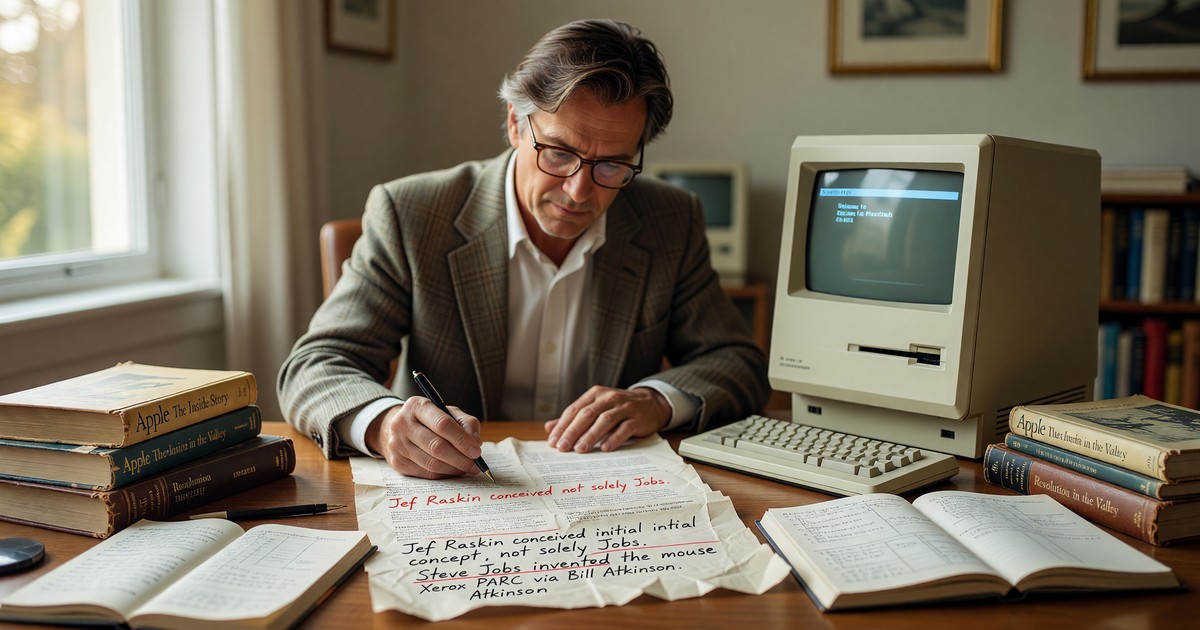
Jef Raskin’s original essay appeared on the earlier raskincenter.org site. This page provides editorial context and commentary on that essay, not the essay itself.
When a product becomes famous enough, its origin story gets simplified. Then it gets mythologized. Then the mythology becomes, for most purposes, the official history. Jef Raskin wrote this essay to address the mythology around the Macintosh — specifically the systematic omission of his role in creating it, and the corresponding inflation of others'.
This is not a small matter of personal credit. When the history of a technology is wrong, we lose the ability to learn from it accurately. Understanding what the Macintosh was, where it came from, and what problems it was designed to solve requires understanding who actually designed it and why.
The Standard Account
The dominant narrative of Macintosh history goes roughly like this: Steve Jobs visited Xerox PARC in 1979, saw the Alto computer with its graphical interface and mouse, and brought the idea back to Apple. Jobs then took over the Macintosh project, drove it with his perfectionism and vision, and the result was the machine that changed personal computing.
Jobs’s role was real and significant. This essay is not about diminishing it. But the standard account omits, misattributes, and compresses in ways that produce a fundamentally inaccurate picture.
What Raskin Actually Did
Jef Raskin was hired by Apple in January 1978 as manager of publications. He had a doctorate from UC San Diego, had taught at UCSD and elsewhere, and had been interested in the intersection of computing and human cognition long before he arrived at Apple.
By 1979, Raskin had developed a detailed vision for a small, low-cost, highly integrated personal computer — not as an engineering exercise but as a product design exercise grounded in his work on human-computer interaction. He wrote a series of internal Apple papers, collectively known as the “Macintosh” documents, proposing a computer that was easy enough to use that people could learn it without a manual.
The name “Macintosh” was Raskin’s idea, chosen as a deliberate misspelling of his favorite apple variety. The fundamental design goals — sub-$1000 price, small integrated form factor, application software included, no user-serviceable components, interface that required no prior computing experience — were Raskin’s. The focus on making the machine approachable for non-technical users was Raskin’s.
The PARC Visit
The Xerox PARC visit in December 1979 — which Raskin helped arrange, a detail often omitted — did show Apple engineers, including Jobs, an early graphical interface. This was influential. But several points get collapsed in the standard telling.
First, Raskin had been developing his interface ideas before the PARC visit, based on his research and earlier work. He was not inspired by PARC; he was already working in the same conceptual space, as were the PARC researchers themselves. Second, the PARC Alto’s interface was considerably more complex and expensive than what Raskin was designing toward. Third, many of the specific design decisions that made the Macintosh interface what it was — the menu bar, the single-button mouse, the trash can, the specific behaviors of windows and dialogs — were worked out at Apple by Apple engineers, not copied from PARC.
Jobs and the Project
Steve Jobs became involved with the Macintosh project in 1981 after being removed from the Lisa project. His involvement transformed the project — in terms of resources, urgency, and team culture. Jobs’s influence on the final product was profound. But there is a meaningful difference between taking over a project that exists and inventing it.
Raskin left the Macintosh project in 1981, pushed out by conflicts with Jobs over design decisions and project direction. The machine that shipped in 1984 was substantially different from Raskin’s original concept — faster, more capable, more expensive, with a different interface aesthetic. Jobs made it his own. But he made it from something Raskin had created.
The Pattern in Tech History
Raskin’s essay situates his own case within a broader pattern he observed in how technical history gets written. The inventor and the promoter are often conflated. The person who creates the original idea and the person who makes it commercially successful are different people, and the second person is usually more famous.
This pattern has real consequences. It affects what engineers and designers think about how innovation happens. If the story is “visionary executive has an idea and drives it to completion,” that is a different lesson from “researcher identifies a problem, spends years developing a conceptual framework, a project is built on that framework and then transformed by commercial forces.” Both stories contain lessons. Only one of them is accurate for the Macintosh.
What Raskin Was Right About
Raskin’s original design specifications for the Macintosh deserve attention on their own merits, independent of credit disputes. Many of his original ideas — the emphasis on consistency, the expectation that the user would never need to read a manual, the belief that the interface itself communicated its affordances — proved durable. The principles he articulated in this context he later extended in his book The Humane Interface, which remains influential in HCI education.
His insistence that computers should adapt to human cognition rather than requiring humans to adapt to computers was not obvious in 1979. The dominant assumption in personal computing was that learning to use a computer was like learning a new skill — that the user was expected to put in effort. Raskin disagreed. He thought that expectation was a design failure, not a user failure. The Mac, whatever its evolution from his original vision, was built on that premise.
Accuracy as Practice
Raskin cared about this history not primarily out of wounded pride — though he was plainly frustrated — but because inaccurate history is a kind of intellectual pollution. It makes it harder to understand what actually happened, which makes it harder to learn the right lessons from it.
The holes in the history of the Macintosh are not unique. They appear in the history of almost every significant technology. The names that survive are the names of people who were visible at the moment of triumph. The earlier work, the conceptual foundation, the years of development before commercial forces took over — these tend to recede.
Raskin’s essay is an attempt to fill in some of those holes. It should be read as an act of historical housekeeping: not revisionism, but restoration.
Related Works
- Jef Raskin’s home page and biography
- The Humane Interface — the book that extended his Macintosh-era thinking into a comprehensive interface design theory
- Curriculum vitae — full record of Raskin’s work, publications, and positions
This page is part of the Jef Raskin Reference, providing editorial commentary on the published works of the creator of the Macintosh project at Apple and the author of The Humane Interface.