April 13, 2017
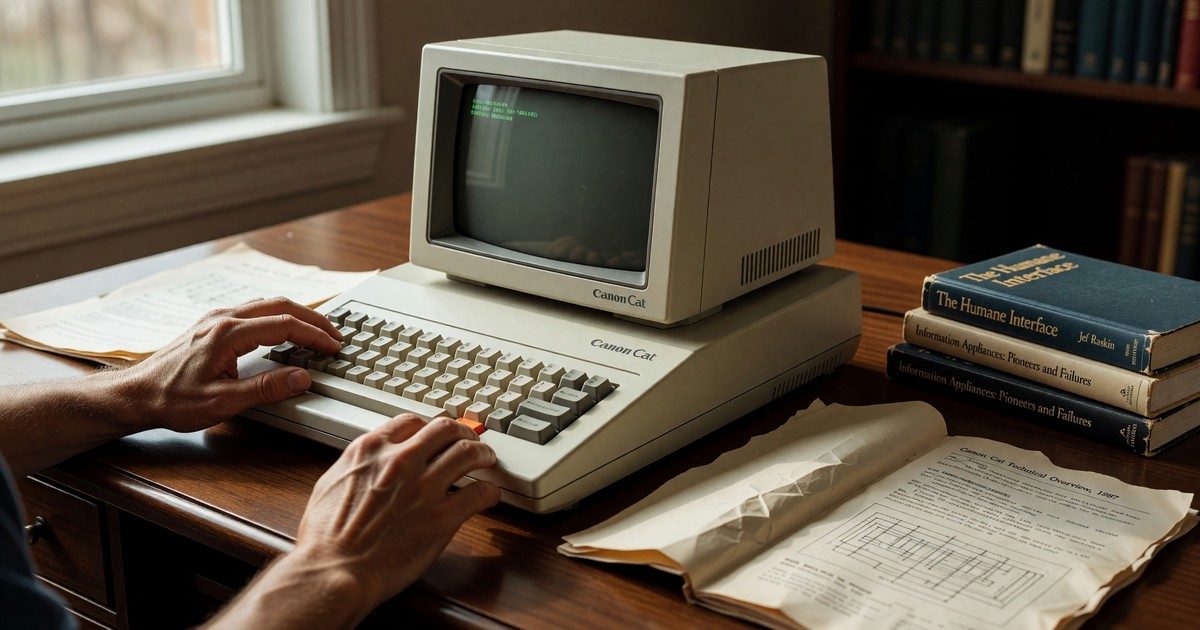
The Canon Cat went on sale in 1987 and was discontinued within roughly six months. Three decades later it is remembered, when it is remembered at all, as a curiosity: the strange keyboard-driven word processor with no mouse and no files, designed by the man who had originated the Macintosh project and then left Apple. The curiosity framing undersells it. The Cat was the most complete physical embodiment of Jef Raskin’s interface theory ever shipped, and on its thirtieth anniversary it is worth taking seriously as a design — not as a footnote, but as an argument that the rest of the industry mostly declined to hear.
What the Machine Was
The Cat was a self-contained unit: a monochrome screen, a keyboard, a disk drive, and the computing hardware, all in one enclosure. It cost around $1,500 and was marketed as an advanced work processor for office use. That positioning, in hindsight, was part of its problem — it sounded like a typewriter when it was something stranger and more ambitious.
There was no operating system the user could see. There were no applications to launch and no files to name, save, or organize in folders. You turned the Cat on and you were writing. Your work persisted automatically. When you wanted to find something — a word, a passage, a previously entered note — you held the LEAP key and typed, and the cursor flew to the nearest match, refining as you typed. Navigation, search, and editing were a single continuous activity conducted almost entirely from the keyboard. The reference documentation for these behaviors is preserved in this archive’s Canon Cat reference material and user manual.
The design was modeless to an unusual degree. Raskin had spent years arguing that modes — states in which the same action produces different results — were a primary cause of user error, and the Cat was his demonstration that a real, shipping product could largely avoid them. There was no “command mode” versus “insert mode,” no application boundaries to cross, no dialog boxes seizing control. The machine tried to maintain a single, predictable relationship between what you did and what happened.
What It Got Right
Judged on its interface principles, the Cat got a remarkable amount right, and the subsequent thirty years have confirmed several of its bets.
Universal search — the idea that you should find anything by typing rather than by navigating to it — became, decades later, a standard expectation, as desktop search and integrated system search arrived on mainstream computers. The Cat had it as the foundation in 1987.
Instant availability — the machine working the moment it was switched on, with no boot ritual and no setup — anticipated a quality that would later be praised in a generation of simpler, appliance-like devices. The persistence of work without an explicit save step, which the Cat handled transparently, is something software is still, in 2017, only partially good at.
And the broad bet that a keyboard-centric, type-to-find interface is faster and less error-prone for skilled work than pointing and clicking has been quietly vindicated by the return of command-driven interaction in the tools used by people who work intensively in a single application.
Why It Failed Anyway
If the design was so prescient, the obvious question is why the Cat lasted six months. The answer is mostly not about the interface.
The clearest factor was internal Canon politics. The Cat originated outside Canon’s main computing efforts, and accounts of its cancellation point to corporate friction rather than market rejection — the product lacked a powerful internal champion and was discontinued before it had a real chance to find its audience. A design can be excellent and still die because the company selling it loses interest.
There were genuine product factors too. The Cat’s positioning was confused: it looked like a dedicated word processor at a moment when the general-purpose personal computer was winning the office, and buyers reasonably asked why they should purchase a single-purpose machine when a PC could do that job and many others. The very integration and specialization that made the Cat coherent also made it look limited next to expandable, multi-application computers.
And the Cat asked users to abandon habits. Mainstream computing in 1987 was already organizing itself around files, applications, and increasingly the mouse. The Cat’s refusal to participate in that model — no files, no applications, no mouse — was intellectually principled and commercially isolating. It demanded that users trust an unfamiliar way of working, and most did not get the chance to, because it was gone before word could spread.
The Anniversary’s Lesson
Thirty years on, the Cat is best understood not as a failed product but as a successful experiment whose results were filed and forgotten. It demonstrated that an aggressively modeless, search-centric, instantly-usable interface could be built and shipped, and that real people could use it productively. The experiment worked. The market, for reasons largely unrelated to the interface, never got to render a verdict.
Many of the Cat’s ideas have since returned in diluted form — search as a primary navigation method, instant-on devices, the keyboard-driven command palette. None of these revivals credit the Cat, and most of their creators were probably unaware of it. That is the ordinary fate of an idea that ships ahead of the conditions that would reward it: it is reinvented later, in pieces, by people who never knew it existed whole.
Raskin would likely have insisted on the distinction between being wrong and being early. The Cat was not wrong. It was early, isolated, and abandoned by the company that owned it. Three decades later, the parts of it that the industry eventually adopted suggest he had the design substantially right the first time.
Further Reading
- The Canon Cat reference manual and user manual — primary documentation in this archive
- Spotlight and the long history of universal search — where the Cat’s search idea eventually surfaced
- Canon Cat, Wikipedia
- Computer History Museum — primary materials on the Cat
Part of the Jef Raskin Reference, providing editorial commentary on the published works of the creator of the Macintosh project at Apple and the designer of the Canon Cat.