May 12, 2022
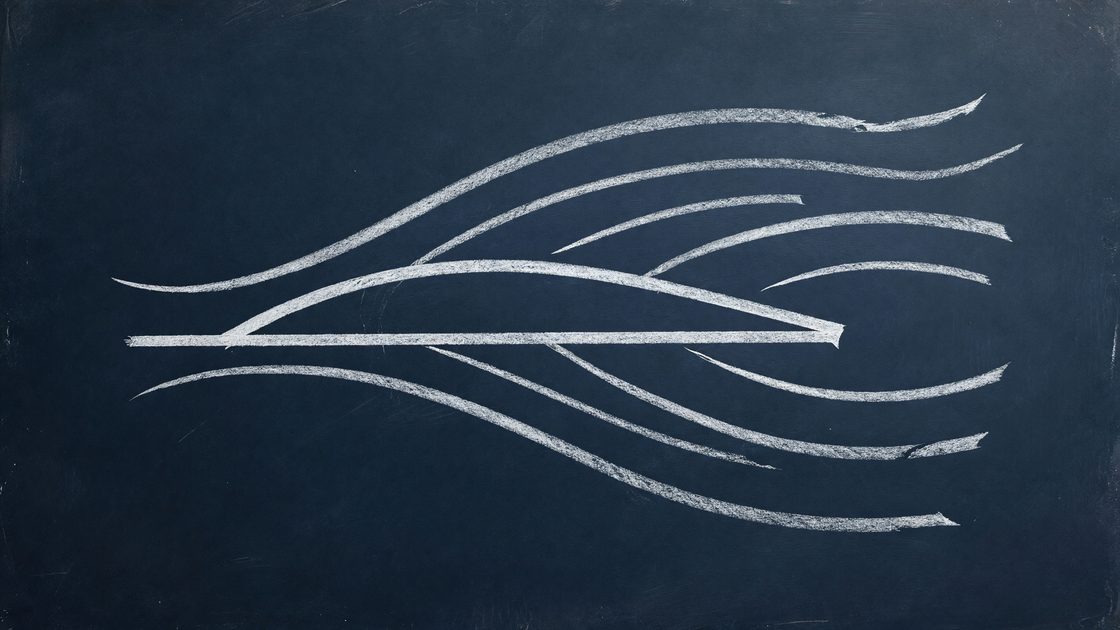
Jef Raskin is remembered here almost entirely as an interface theorist, and for good reason — that is where his lasting influence lies. But Raskin held a physics degree, wrote and lectured on aerodynamics, and returned more than once in his published essays to a specific, persistent piece of bad science education: the popular explanation of how airplane wings generate lift, built around Bernoulli’s principle and an assumption about air travel time that turns out not to be true. His writing on this subject, preserved elsewhere on this site in the original essay form, deserves its own editorial treatment, because the myth he was arguing against is not a settled historical curiosity. It is still being taught.
The Myth, Stated Plainly
The explanation shows up in flight-training materials, general physics textbooks, and museum placards with remarkable persistence: a wing’s upper surface is curved and longer than its flatter lower surface, so air traveling over the top has farther to go. The theory then asserts that air molecules separating at the wing’s leading edge must reunite at the trailing edge — arriving at the same time — which means the air on top must travel faster to cover the longer path. Faster-moving air means lower pressure, by Bernoulli’s principle, and the pressure difference between the slower air below and the faster air above produces lift.
It is a tidy, intuitive story. It is also, on the specific “equal transit time” claim at its center, not true.
Why the Standard Explanation Fails
NASA’s Glenn Research Center, which maintains public educational material specifically to correct this misconception, states the problem without hedging: there is no physical law requiring that air separated at a wing’s leading edge must reunite at the trailing edge. It doesn’t. Measurements and computational fluid dynamics both show that air traveling over the top of a wing typically reaches the trailing edge well before the corresponding air traveling underneath — the “equal transit time” assumption that anchors the popular explanation is simply false to observation, not a simplification of something true.
The consequences of that false premise compound. Because the assumption undercounts how much faster the air over the wing is actually moving, the equal-transit-time version of the Bernoulli explanation predicts substantially less lift than wings actually produce — the theory is not merely imprecise, it gets the magnitude wrong by a wide margin. And it cannot account for symmetrical airfoils, which have no meaningful difference in upper- and lower-surface path length at all, yet still generate lift at a positive angle of attack. A theory that can’t explain how a symmetrical wing flies is not describing the actual mechanism.
Where Raskin’s Argument Fit
Raskin’s published writing on aerodynamics, most visibly his essay on the Coanda effect — already treated in detail elsewhere on this site — approached the same underlying problem from a different direction than NASA’s transit-time correction. Where the standard myth invokes Bernoulli via a false transit-time assumption, Raskin’s account emphasized the physical tendency of a moving fluid to follow a curved surface (the effect named for physicist Henri Coandă) and the resulting downward deflection of airflow off the wing’s trailing edge, consistent with a Newtonian, deflection-based account of lift generation rather than a purely pressure-differential one.
This is not a fringe position Raskin invented on his own. The debate among physics educators over whether lift is better explained through Bernoulli’s pressure-based framework, a Newtonian reaction-force framework, or — the position most contemporary aerodynamicists actually hold — a combination of both describing the same underlying flow from different mathematical angles, predates Raskin’s essay and continues in aviation-education literature today. What Raskin’s writing contributed to that ongoing conversation was a cognitive scientist’s specific complaint: that the popular version of the Bernoulli explanation was not simply an oversimplification of correct physics, but a claim built on a factually false premise about air molecules “needing” to arrive together, presented to students as settled fact rather than as the contested simplification it actually is.
Circulation, the Kutta Condition, and the More Complete Account
The more technically complete modern explanation of lift, favored by most working aerodynamicists, does not simply swap “Bernoulli” for “Newton” — it describes both as consistent descriptions of a single underlying flow phenomenon called circulation. A wing moving through air generates a net circulating flow around its cross-section, a consequence of viscosity and the wing’s sharp trailing edge enforcing what’s known as the Kutta condition — the physical requirement that air flows smoothly off the trailing edge rather than curling back around it. This circulation, superimposed on the oncoming airflow, produces exactly the pattern the popular myth intuits badly: genuinely faster air over the top surface, genuinely slower air underneath, and a genuinely lower pressure above than below. The circulation account gets there through the actual physics of viscous flow meeting a shaped surface, not through an invented rule about particles needing to reunite at the trailing edge.
This is worth spelling out because it clarifies what’s actually wrong with the popular myth and what isn’t. Bernoulli’s equation itself — the relationship between fluid speed and pressure along a streamline — is not the error. Newtonian reaction forces from deflected air are also not wrong; they describe the same flow from a different, equally valid mathematical vantage point. The specific error is the invented justification bolted onto the Bernoulli explanation to make it teachable: the false claim that air must arrive at the trailing edge simultaneously. Strip that false justification away and replace it with the circulation account grounded in the Kutta condition, and the pressure-based and force-based descriptions become two complementary views of one correct underlying physics, which is the position aerodynamicists actually hold and the position Raskin’s own writing, working from a physics rather than an aviation-education background, moved toward independently.
A Physicist’s Argument, Consistent With the Interface Theorist’s Method
There is a real continuity between this strand of Raskin’s writing and the interface work he is remembered for, even though the subject matter has nothing to do with computers. Raskin’s core professional habit — documented throughout the rest of this site’s coverage of his interface theory — was distrust of an explanation that felt intuitively satisfying but did not survive contact with careful measurement. The equal-transit-time explanation of lift is exactly that kind of explanation: it sounds right, it is taught confidently, and it does not match what instruments actually record. Raskin’s willingness to take on a widely taught physics misconception, using the same insistence on evidence over intuitive appeal that shaped his interface writing, is a useful reminder that his skepticism toward comfortable, unexamined explanations was not limited to software.
Why the Myth Persists Despite the Correction
NASA’s public correction of the equal-transit-time theory has existed for years, and the physics community’s preference for a more complete deflection-and-pressure account of lift is not new. The myth persists anyway, for reasons that will be familiar to anyone who has read Raskin’s own essay on how computing forgets its own history, treated elsewhere on this site: the simple, wrong explanation is easier to teach, easier to draw on a whiteboard, and requires no engagement with computational fluid dynamics or the more genuinely subtle physics of circulation and pressure fields. The correct account is available, has been available for a long time, and continues to lose to the more teachable wrong one — the same structural dynamic Raskin diagnosed in a completely different field.
Frequently Asked Questions
Did Jef Raskin have a background in aerodynamics?
Raskin held a physics degree and wrote and lectured on aerodynamics topics alongside his better-known interface-design career; his essay addressing lift and the Coanda effect is preserved in this site’s archive of his published work.
What is the “equal transit time” theory of lift, and why is it wrong?
It is the claim that air separating at a wing’s leading edge must reunite at the trailing edge at the same time, requiring faster airflow over the longer, curved upper surface. NASA’s Glenn Research Center states plainly that no such requirement exists physically, and that air over a wing typically arrives at the trailing edge before the corresponding air underneath — the assumption is false, not merely simplified.
Did Raskin argue against Bernoulli’s principle itself?
No. Bernoulli’s principle is a correct and widely used description of the relationship between fluid speed and pressure. The dispute is over the false “equal transit time” assumption commonly paired with it to explain lift, not over the validity of Bernoulli’s equation itself.
Is there a scientific consensus on how wings generate lift?
Most contemporary aerodynamicists describe lift through a combination of pressure differences and Newtonian reaction forces from deflected airflow, treating these as complementary descriptions of the same physical flow rather than competing theories. The specific “equal transit time” justification for the Bernoulli explanation is the part considered incorrect, not the broader use of pressure-based reasoning.
Why does this physics essay belong on a site about interface design?
Raskin’s willingness to challenge a comfortable, widely taught but factually incorrect explanation reflects the same evidence-over-intuition standard that shaped his interface-design writing, documented throughout this site. The subject matter differs; the underlying method does not.
Related: