July 21, 2022
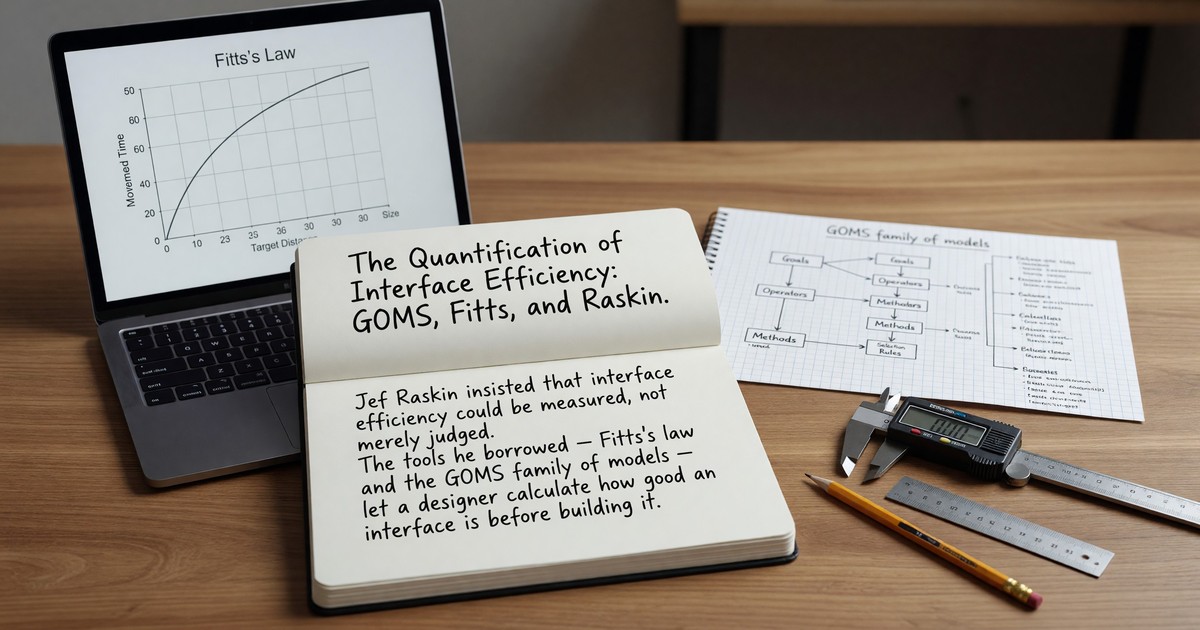
One of the more demanding chapters of The Humane Interface (Addison-Wesley, 2000) is the one in which Jef Raskin argues that interface efficiency is a quantity — something you can calculate, compare, and optimize — rather than a matter of taste. The claim is easy to state and hard to accept, because accepting it means giving up the comfortable position that interface quality is ultimately subjective. Raskin did not think it was. He thought a great deal of it could be put on a number line, and he showed how.
This piece looks at the two intellectual tools Raskin leaned on for that argument — Fitts’s law and the GOMS family of models — and at what it means to take them seriously, twenty-two years after he made the case.
Fitts’s Law: Pointing as Physics
In 1954, the psychologist Paul Fitts published a result that has anchored interface measurement ever since. Studying rapid, aimed movements, Fitts found that the time to move to a target is a predictable function of the distance to the target and its size: targets that are farther away or smaller take longer to hit, and the relationship is regular enough to be written as an equation. The original paper appeared in the Journal of Experimental Psychology and has been cited many thousands of times in the decades since.
Fitts was not studying computers — there were almost none to study in 1954. He was studying human motor performance. But his law translated almost directly to the era of the mouse and the on-screen target. A button’s size and its distance from the cursor’s likely starting point determine, with surprising accuracy, how long it will take a user to click it. This is not opinion. It is measurement, and it is repeatable.
Raskin used Fitts’s law to make a point that designers found uncomfortable: the placement and size of controls is not a stylistic choice. It has a measurable cost in user time, paid by every user on every use, forever. A frequently used control placed far from where the cursor usually sits is a quantifiable inefficiency. The pull-down menu at the top of the screen versus the menu attached to a window, the size of a touch target, the distance between a confirmation button and a cancel button — all of these have consequences that can be calculated rather than debated.
GOMS: Modeling the Whole Task
Fitts’s law handles a single pointing movement. Real tasks are sequences of many actions — looking, deciding, reaching, typing, clicking. To reason about whole tasks, Raskin drew on the GOMS family of models introduced by Stuart Card, Thomas Moran, and Allen Newell in their 1983 work The Psychology of Human-Computer Interaction.
GOMS stands for Goals, Operators, Methods, and Selection rules — a way of decomposing a task into the elementary operations a user performs and the times those operations take. The simplest version, the keystroke-level model, assigns approximate durations to each basic action: a keystroke takes so long, a pointing movement takes so long (computed via Fitts’s law), a mental preparation step takes so long. Add up the operators in a task and you get a predicted time to complete it — before anyone has built the interface.
This is the part of Raskin’s argument that sounds almost too strong. You can, in principle, calculate that one design will be faster than another, by how much, without testing it on a single user. The prediction is not perfect; it ignores learning, fatigue, and error recovery. But it is good enough to settle many design arguments that would otherwise be settled by whoever in the room has the most authority.
Raskin combined these tools into a measure he discussed at length: the efficiency of an interface for a given task, expressed roughly as the ratio of the information the user must actually supply to the work the interface makes them do. An interface that forces a user to perform many operations to express a small amount of intent is inefficient in a precise, computable sense. One that lets a small number of actions express the intent is efficient. The Canon Cat’s LEAP mechanism, which Raskin designed, scores well on this measure precisely because it collapses navigation, search, and command into a single learned gesture.
Why Designers Resisted the Numbers
If the efficiency of an interface can be calculated, why is calculation so rarely done? Raskin had answers, and they have aged well.
The first is that the numbers are often unwelcome. A keystroke-level analysis frequently reveals that a visually impressive design is slower than a plain one. Animations, multi-step confirmations, and decorative interactions all add operators, and operators cost time. Measurement tends to favor the austere over the ornate, and the people commissioning software often want the ornate.
The second is that measurement requires defining the task, and defining the task requires admitting what the software is actually for. A vague brief cannot be measured. Raskin’s method forces a specificity that some organizations would rather avoid.
The third is cultural. The field had decided, largely, that interface quality was a design sensibility — a thing you had or did not have. Raskin’s claim that much of it was arithmetic threatened the standing of taste. Arithmetic is teachable and checkable; taste is neither, and is therefore a more comfortable basis for authority.
What Holds Up in 2022
The specific tools Raskin used are still in use and still taught. Fitts’s law remains a standard reference in interface courses and is routinely invoked in discussions of touch-target sizing and pointer design. The GOMS models remain part of the human-factors literature and underpin specialized predictive-modeling tools used where performance genuinely matters — high-volume data entry, transaction terminals, safety-critical control panels.
What has not held up is the general expectation that ordinary commercial interface work should be grounded in these measurements. The tools sit in the academic and specialist toolbox; they are not the default working method for the typical product team, which still reasons mostly from preference and precedent. This is the same gap that runs through Raskin’s broader program — the science exists, the application is possible, and the application mostly does not happen.
The reason to keep returning to this chapter is that the underlying facts do not expire. Fitts’s law described human motor performance in 1954 and describes it now. The keystroke-level model’s operator times have proven remarkably stable across decades and device types. Raskin’s claim was never that his specific numbers were eternal; it was that interface efficiency is the kind of thing that has numbers at all. That claim is correct, and acting on it remains the exception rather than the rule.
Related: