February 16, 2023
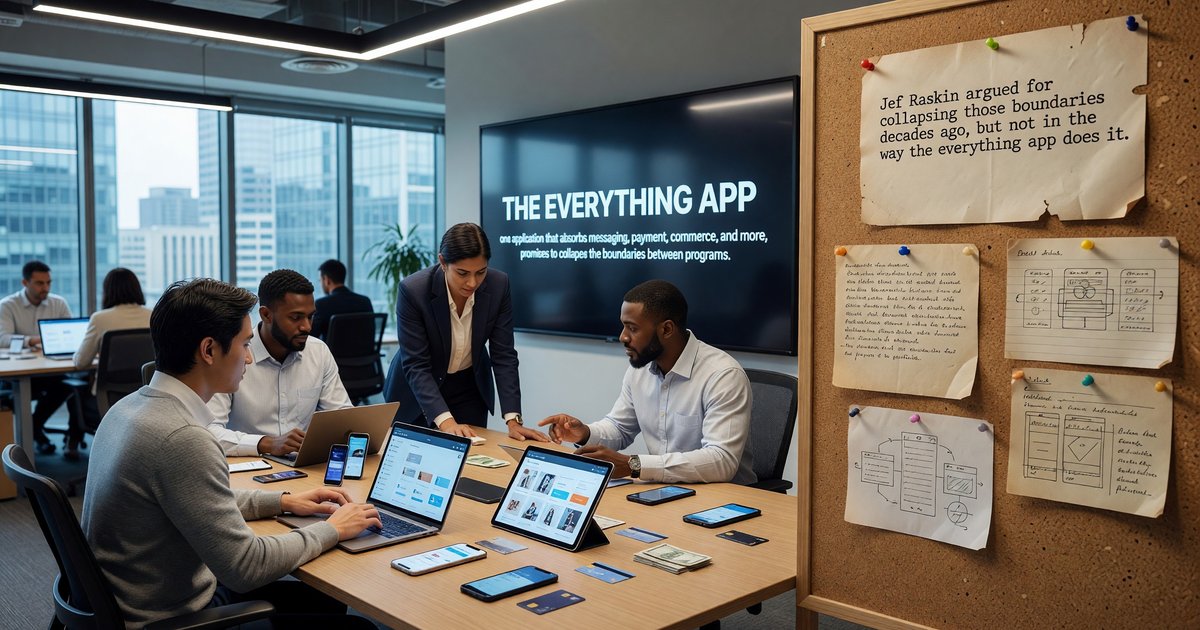
There is a recurring ambition in software to build the one application that does everything — the program a person never has to leave. In 2023 the ambition has a name borrowed from the markets where it is furthest along: the super-app, or the everything app. WeChat is the canonical example, a single Chinese application through which hundreds of millions of people message, pay, shop, hail rides, and transact with government services without ever switching programs. Western technology companies talk openly about wanting to build the equivalent. The browser startup Arc, among others, is reorganizing the desktop around a single integrating surface rather than a scatter of separate windows.
Jef Raskin spent his career arguing that the boundaries between applications were artificial and harmful. It is tempting, then, to read the everything app as a vindication of his ideas. The reading does not quite hold. Raskin wanted to dissolve application boundaries, but in a direction almost opposite to the one the super-app takes. The difference is instructive, and it turns on what he meant by modeless.
What Raskin Was Actually Against
Raskin’s objection to applications was not that there were too many of them to fit in one place. It was that the application itself is a mode — a state in which the same user action means something different than it would elsewhere. In The Humane Interface, he treated the application as the largest and most pervasive mode in modern computing. Inside a word processor, a keystroke writes a letter; inside a spreadsheet, the same keystroke might trigger a command; inside a drawing program, it might do nothing at all. The user must constantly track which application is in front and adjust their expectations accordingly.
His proposed alternative, developed in the Canon Cat and later in the Archy project at his research center, was a computing environment with no applications at all — only content and a uniform set of commands that worked the same way on any content. You did not “open the word processor”; you typed, and the same LEAP gesture found text, executed commands, and navigated, regardless of what kind of material you were working on. The boundaries dissolved because the modes dissolved. There was nothing to switch between because there were no separate states to be in.
That is the modeless ideal: not one giant program, but the absence of the program as a distinct, mode-defining container.
How the Everything App Differs
The super-app collapses boundaries in a different sense. It does not eliminate the separate functions; it nests them. Inside WeChat, payment is still a distinct facility with its own conventions, commerce is another, messaging another. The user no longer switches between separate applications at the operating-system level, but they switch between separate modes inside the single application just as much as before — arguably more, because the modes are now hidden behind a unified surface that makes the boundaries less visible rather than truly absent.
By Raskin’s analysis, this is not progress toward modelessness. It is the relocation of modes. The mode-tracking burden the user carried at the OS level — which application am I in? — reappears at the in-app level — which section of the super-app am I in, and what do my actions mean here? The unification is real at the level of branding and account and convenience. At the level of cognition, the user is still managing state, still liable to the error of acting as though they are in one section when they are in another.
There is even a case that the super-app makes the mode problem worse. Separate applications at least announce themselves clearly — a different window, a different name, a different visual identity. A super-app’s internal sections often share a chrome and a visual language precisely to feel seamless, which means the boundaries between modes are softened exactly where the user most needs them to be sharp.
The Integrating Surface
The desktop reorganizers — the browser-as-workspace projects of which Arc is the most discussed in 2023 — sit somewhere between the two ideas. They do not absorb every function into a single program; they provide a single organizing surface through which the user reaches many separate things. This is closer to Raskin’s instinct, in that it attacks the navigation problem: the friction of finding and switching among the many places a person’s work lives.
But it stops well short of the modeless ideal, because the things it organizes are still applications and sites with their own modes. A unified launcher and a tidy sidebar reduce the cost of switching. They do not eliminate the switching, and they do not make the destinations behave uniformly once reached. Raskin’s point was always that a faster way to switch between modes is a smaller improvement than removing the need to switch at all. The integrating surface delivers the former.
What Would Have Satisfied Him
It is worth being concrete about what an everything app built on Raskin’s principles would have looked like, because the contrast clarifies the present designs.
It would have a single interaction model that worked identically across messaging, payment, commerce, and the rest — not a shared visual style, but a shared grammar of action, so that the gesture to find something, the gesture to act on it, and the gesture to undo were the same everywhere. It would minimize hidden state, making it always evident what a given action would do, rather than relying on the user to remember which section they were in. It would treat the absence of separate modes as the design goal, not the appearance of seamlessness as a marketing goal.
No shipping super-app of 2023 is built this way, and the commercial reasons are not hard to find. The everything app’s business value lies precisely in the separate functions — each is a distinct revenue stream, a distinct dataset, a distinct partnership. A truly modeless design would blur exactly the boundaries the business depends on keeping legible to itself, if not to the user.
The Standing Lesson
The everything app is a genuine convenience and, in some markets, a genuine reorganization of daily life. Raskin’s framework does not deny that. What it denies is the easy assumption that absorbing many functions into one application is the same thing as the modeless computing he argued for. Consolidation of ownership is not consolidation of interaction. A single program can contain as many modes as a hundred programs did, and hide them better.
The test Raskin would have applied is the one his work always applied: does the user have to track hidden state to predict what their actions will do? On that test, the everything app does not pass simply by being one app. It passes only if it is genuinely modeless — and so far, none of them are.
Related: