November 15, 2016
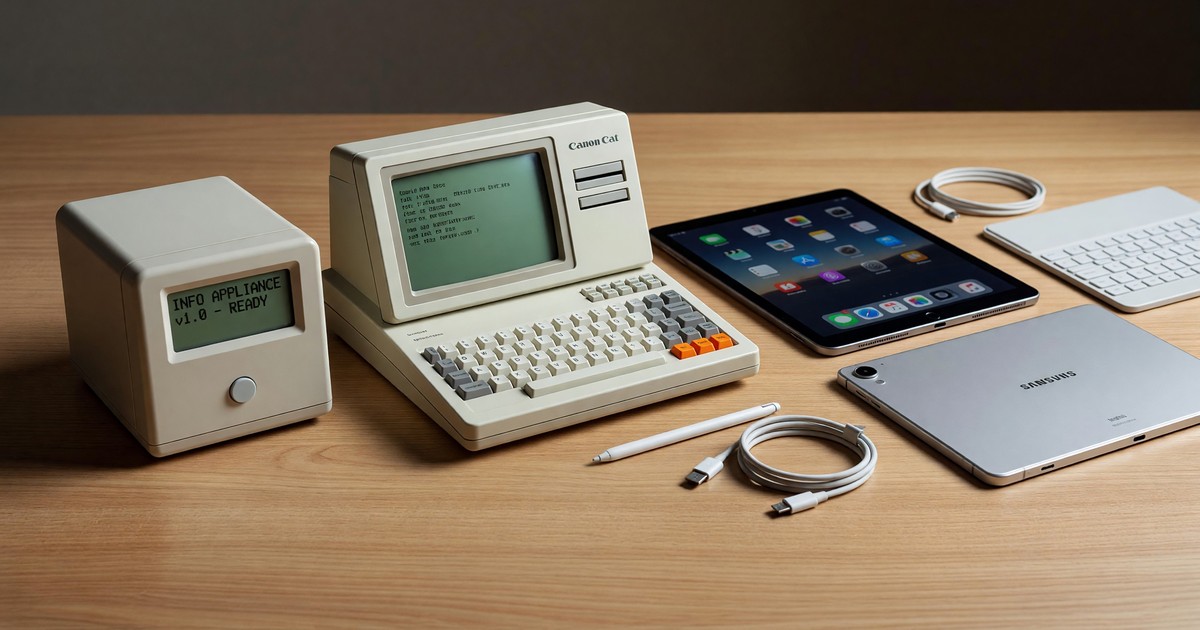
The phrase “information appliance” did not originate with Jef Raskin, but few people did more to give it a concrete meaning. He named a company after it — Information Appliance, Inc., which he founded after leaving Apple — and he spent years arguing that the personal computer, as it existed in the 1980s and 1990s, was a transitional and badly designed object that ought to give way to something simpler.
The argument is worth revisiting in 2016, because the intervening years have produced devices that look, superficially, like the appliances Raskin described. The tablet, in particular, is routinely praised in exactly the terms he used: instantly on, no setup, usable by a child or a grandparent, as ordinary as a household tool. Whether these devices actually realize his idea, or merely resemble it, is a more interesting question than the marketing suggests.
What Raskin Meant
Raskin’s appliance argument rested on an analogy he returned to often. A toaster does one thing, does it without instruction, and demands no understanding of its internals. You do not configure a toaster. You do not maintain it. You do not learn it. You use it, and it disappears into the background of daily life. Raskin believed computers should aspire to that condition — not by becoming less capable, but by hiding their complexity so thoroughly that the user never had to confront it.
The personal computer of his era failed this test comprehensively. It required setup, maintenance, a model of files and folders, an understanding of applications, and a tolerance for failure modes that no appliance would survive in the market. Raskin saw this not as the price of power but as a design failure — the same failure he had been describing since his Macintosh memos a decade earlier. The information appliance was the cure: a device specialized enough, and designed carefully enough, that it could be used the way you use a kitchen tool.
His own attempt at building one, the Canon Cat, embodied much of this. It turned on instantly, had no operating system the user could see, no files to manage, and no applications to install. It was, in his framing, an information appliance for writing.
The Devices That Came
By 2016 the landscape includes several devices that wear the appliance idea more openly than the desktop computers Raskin criticized. The tablet, introduced to the mass market in 2010, is the most prominent: it boots in seconds, requires little setup, hides its file system from casual users, and is genuinely usable by people who never mastered a conventional computer. The inexpensive, browser-centric laptop has carved out a similar position in education, trading general-purpose capability for simplicity and low cost. E-readers are appliances in the strictest sense — single-purpose devices that do one thing without ceremony.
In each case, something Raskin asked for has arrived. The setup ritual is reduced. The file system recedes. The device is approachable by novices. The toaster standard is, in places, nearly met.
Where the Resemblance Breaks Down
And yet a careful reading of Raskin’s idea finds the modern devices wanting in ways that matter.
The first divergence is the application. Raskin’s appliances were specialized and self-contained; the tablet is a general-purpose computer with the file system hidden, running an ecosystem of thousands of separate applications, each with its own interface, its own modes, and its own conventions. The user is spared the file system but handed application-switching, account management, update prompts, and a fresh interface to learn for every task. The complexity did not vanish. It moved.
The second divergence is maintenance. A toaster does not ask to be updated, does not require an account, does not negotiate permissions, and does not nag. Modern appliance-like devices do all of these. They are, in this respect, less appliance than the Canon Cat was three decades ago. The Cat asked nothing of you between turning it on and writing. A tablet asks a great deal.
The third, and the one Raskin would have pressed hardest, is the persistence of modes and hidden state — the very problems his interface theory was built to eliminate. The appliance ideal was an interface so transparent that the user always knew what the system would do. The actual devices are riddled with states the user cannot see and cannot reliably predict, from keyboard shift behavior to which application currently owns the screen.
The Honest Assessment
It would be wrong to say the information appliance never arrived. In the narrow sense — instant-on, low-setup, novice-usable devices that have escaped the desktop’s worst frictions — it plainly did, and the tablet is its clearest expression. Raskin’s diagnosis of the 1990s personal computer as needlessly hostile to ordinary people has been substantially vindicated by the market’s enthusiasm for simpler devices.
But the deeper version of his idea — a device whose internal complexity is genuinely eliminated rather than merely concealed behind a friendlier surface — remains unrealized. The modern appliance-like device is a general-purpose computer wearing an appliance’s clothes. It hides the file system but keeps the applications. It boots fast but updates constantly. It welcomes novices but still surprises them with hidden state.
Raskin’s standard was exacting on purpose. He was not describing a marketing category; he was describing a design discipline in which the burden of understanding falls entirely on the designer and never on the user. By that standard, the toaster still wins. The devices we call appliances are closer than the computers of 1990, and further from the goal than their advertising claims. Raskin, characteristically, would have noted both.
Further Reading
- Core principles of humane interface design — the hidden-state and modes problem the appliance ideal was meant to eliminate
- The Canon Cat reference manual — Raskin’s own attempt at a writing appliance
- Jef Raskin, Wikipedia
- Computer History Museum — primary materials on early appliance-class devices
Part of the Ideas series — applying Raskin’s principles to current computing.