June 18, 2020
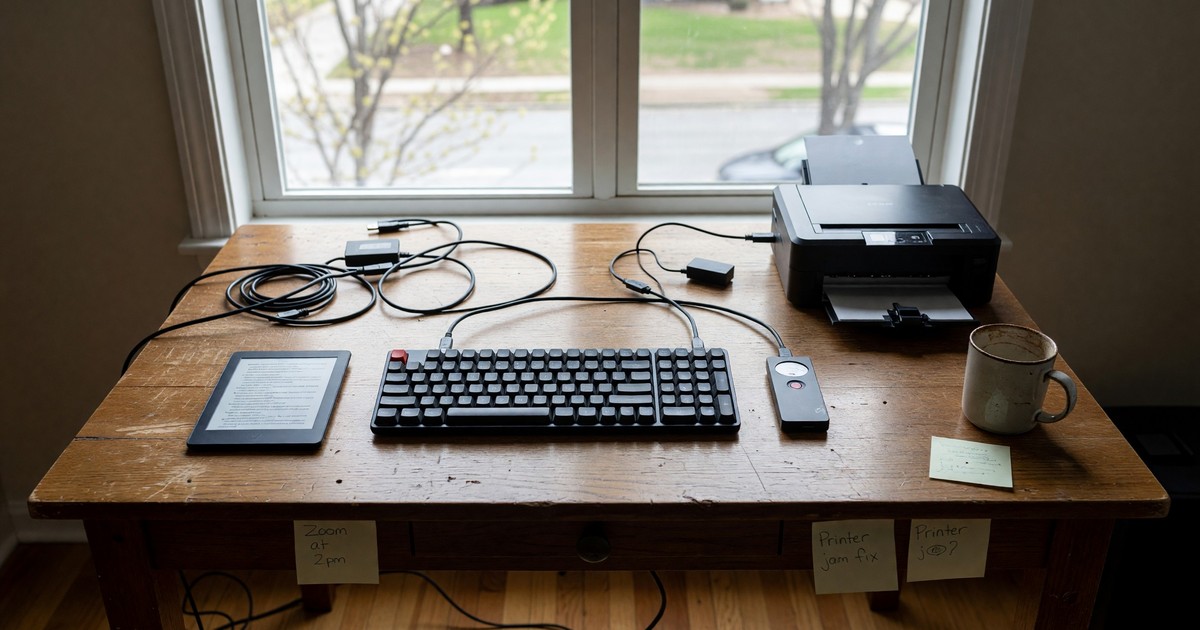
Jef Raskin’s idea of the information appliance is older than most of the people now living inside it. He set it out most fully around 1990: a device built to do one thing, or a small set of related things, so well and so simply that using it required no expertise and no manual — the computational equivalent of a toaster or a telephone rather than a general-purpose machine bristling with capability and complexity. The personal computer, in his view, had taken the wrong turn by trying to do everything; the appliance was the corrective.
This spring has turned that argument into an involuntary experiment. With offices closed and tens of millions of people suddenly working, schooling, and socializing from home, the question of which devices actually serve ordinary users under pressure has stopped being theoretical. The answer that is emerging looks a great deal like the answer Raskin gave thirty years ago.
What Raskin Meant by an Appliance
The information appliance was not merely a small computer. It was a device whose design started from a task rather than from a capability list. A general-purpose computer asks the user to assemble the tools, manage the files, choose the applications, and maintain the system; competence is a prerequisite. An appliance hides all of that behind the single thing it is for. You do not administer a telephone. You do not configure a calculator. You pick it up and it does its job.
Raskin’s complaint about the PC was that its generality came at a cognitive cost paid by every user, expert and novice alike, on every use. The appliance redistributes that cost: the difficulty is absorbed once, by the designer, so that it need not be paid repeatedly by the user. For people who never wanted to become computer administrators — which is most people — this is the humane arrangement.
The Spring’s Unplanned Test
The events of this spring have stress-tested every household’s devices at once, and the test has been unusually clarifying about which designs hold up when ordinary people are forced to rely on them without an IT department down the hall.
The devices that have absorbed the new load most gracefully tend to be the appliance-like ones. Tablets and Chromebooks — single-purpose-feeling, low-administration, hard to break — have surged precisely because a parent setting up a child for remote school, or an older relative joining a video call, does not have to become a system administrator first. A Chromebook that boots into a browser and updates itself silently is close to Raskin’s ideal: the task is visible and the machinery is not. The reports of these devices selling out are, read through his framework, reports of the appliance principle being validated under duress.
The general-purpose computer, by contrast, has shown its costs plainly. The spring’s recurring domestic scene — a family member unable to join a meeting, mics and cameras misconfigured, an update half-installed, a setting buried three menus deep — is the cost of generality coming due all at once, in households without expert help. Raskin predicted exactly this: that the price of a do-everything machine is paid in moments of confusion, and that those moments multiply when the user is stressed and unsupported.
Where the Appliance Idea Falls Short
It would be too neat to declare Raskin simply vindicated, and he would have been the first to refuse the easy conclusion. The spring has also exposed the limits of the appliance vision.
The most obvious is that remote work demands generality. A tablet is a fine appliance for consuming and communicating, but the spring has forced millions to produce from home — to write, compute, design, develop — and production still wants the flexible, capable, and therefore complicated general-purpose machine. The appliance excels at the bounded task and struggles at the open-ended one, and a great deal of knowledge work is open-ended. Raskin’s appliance was always better suited to the consumer and the communicator than to the maker.
There is a second limit he did not foresee in 1990: the appliance’s simplicity is often purchased by moving the complexity into the cloud and the platform, where it becomes invisible to the user but also outside the user’s control. The Chromebook is simple because Google administers it. That is humane in Raskin’s sense — the user is spared the work — but it relocates rather than eliminates the complexity, and it does so by ceding control to the platform owner. Raskin cared about the user’s autonomy as well as the user’s convenience, and the modern appliance often trades the second for a reduction in the first.
What the Year Confirms
With those caveats, the central lesson of this strange spring lands on Raskin’s side. When you take ordinary people, remove their institutional support, and require them to depend on their devices for the basic conduct of life, the devices that serve them best are the ones designed around tasks rather than capabilities — the ones that hide their machinery and demand no expertise. That is the information appliance, and the appliance is winning the part of the contest it was built to win.
The deeper point is the one Raskin always returned to: complexity is not free, and someone always pays for it. The general-purpose computer charges that price to the user, on every use, forever. The appliance charges it once, to the designer, in advance. A year in which everyone has suddenly become the unsupported administrator of their own home office is a year that makes the difference impossible to ignore. Raskin saw it three decades early, when the offices were still full.
Related:
- Modes Came Back: Voice Assistants and Hidden State →
- Aza Raskin, Infinite Scroll, and a Family Argument About Attention →
- The Humane Interface →
- Back to Ideas →
External references: Raskin’s writing on the information appliance is discussed in the HCI literature collected at the ACM Digital Library; for historical context on the appliance concept see the Computer History Museum.