June 26, 2026
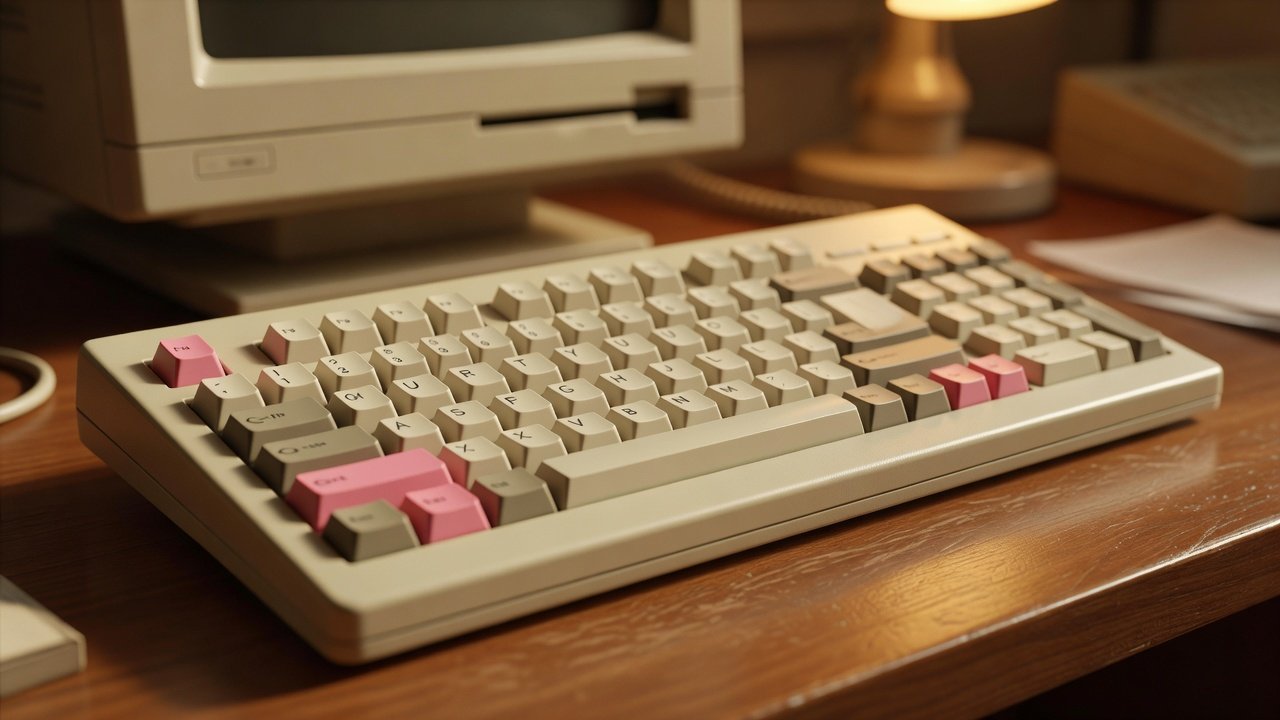
The Canon Cat went on sale in the United States in July 1987. By the end of that year it was gone — discontinued after roughly six months and estimated sales of around 20,000 units. It cost $1,495, looked like a dedicated word processor, and was designed by Jef Raskin, the man who had originated the Macintosh project at Apple before leaving the company in 1982.
Thirty-nine years is a long time to sustain a cult following for a machine that almost no one bought. The Cat has one, and the interest is not nostalgia. Developers have built emulators and web recreations of its interface as recently as 2025. Hacker News threads on the Cat appear with regularity and attract detailed technical discussion. The machine keeps getting rediscovered by people building text editors, command palettes, and conversational AI interfaces, all of whom find in it a design that addressed problems they thought were new.
What the Machine Actually Was
The Cat was a sealed unit: keyboard, monochrome screen, floppy drive, and processor in one enclosure, with no mouse and no pointing device of any kind. It had no operating system the user could see, no files to name, no applications to open. You turned it on and you were immediately working in a continuous document — all your data in a single scrollable stream, persisted automatically, available the moment power came on.
Navigation, search, and editing were unified through a single mechanism. Two LEAP keys, positioned in front of the spacebar, gave the user direct access to any location in the document: hold LEAP, type the first characters of a word or phrase, and the cursor moved to the nearest match, refining continuously as you typed. Releasing the LEAP key left the cursor at the result. There was no separate search mode to enter, no dialog box to dismiss. The mechanism worked identically whether you were navigating within a paragraph, locating a document section, or executing a command — because commands were also text strings the system could LEAP to.
The reference documentation for both the interaction model and the system implementation is preserved in this archive: The Canon Cat user manual and the complete reference.
The Modeless Commitment
What made the Cat unusual in 1987, and what makes it interesting now, is the depth of its commitment to Raskin’s modeless principle. Most software at the time was heavily modal — the difference between command mode and insert mode in vi, between “ready” and “select” states in application menus, between what happened when you typed in a dialog box versus what happened in the main document. The Cat eliminated the category. Every keystroke produced the same kind of result in the same kind of way, regardless of what the system was doing. There was one typing state. The modes that vi users had to track, that menu-driven applications required navigating, simply did not exist.
The practical consequence was a predictable relationship between action and outcome. A user who learned LEAP in the first ten minutes of use had acquired the skill they would use for every subsequent interaction with the machine. Nothing in the Cat required them to learn a different set of conventions for a different context, because there were no different contexts. This is what Raskin called a “monotonic” interface: one in which the user’s model of the system does not have to change as the system is used more.
Why It Failed on the Market
The reasons for the Cat’s commercial failure are documented, though competing accounts emphasize different factors. Raskin himself attributed the failure to marketing — the Cat was positioned toward office clerical workers rather than the professional writers and intensive document workers for whom it was best suited. The LEAP mechanism, which delivers its efficiency gains to fast typists who can exploit incremental search, offers less advantage to users who are not proficient with the keyboard to begin with.
Internal Canon politics also contributed. The product lacked powerful sponsorship within Canon’s main computing divisions, which were invested in conventional personal computers and dedicated word processors. The Cat was developed outside that mainstream and was discontinued before it had accumulated enough users to build market momentum.
The broader context mattered too. By mid-1987, the general-purpose personal computer was clearly winning the office market. A machine that could not run the applications everyone else’s machine ran — no Lotus 1-2-3, no dBASE, no desktop publishing — was making a proposition few buyers accepted. The Cat’s coherence as a single-purpose appliance was intellectually principled and commercially isolating in the same gesture.
None of these factors were failures of the design. The design worked. The 20,000 users who owned Cats were, by most accounts, loyal to them. The Internet Archive’s Canon Cat emulation has been downloaded and run by many more people in 2025 alone than the machine sold in its commercial lifetime. The design did not fail to attract interest. It failed to attract it in 1987, under the conditions of 1987.
What Has Been Recovered, Piecemeal
The ideas Raskin embedded in the Cat have since returned in pieces — usually without acknowledgment of the source, which is the ordinary fate of a design that arrives before the conditions that reward it.
Universal search by typing, which LEAP implemented as the Cat’s primary navigation method, is now a standard expectation. macOS Spotlight, launched in 2004, gave Mac users a LEAP-like experience at the operating system level. The Windows search bar followed. Command palettes — the slash-to-search interfaces now standard in Figma, Linear, VS Code, Notion, and as of iOS 27 in Apple’s system-level Siri AI — are all implementations of the LEAP principle: one typing gesture that reaches everything rather than a hierarchy of menus the user must navigate.
Auto-save and document persistence, which the Cat handled transparently and which the Mac’s explicit save model made optional for decades, is now the standard expectation in Google Docs, Notion, Apple’s own iCloud documents, and most modern web-based editors. The Cat was doing this in 1987 because Raskin considered an explicit save step a mode — a state in which the user must switch from working to managing the work, a tax on attention that the interface had no reason to impose.
Instant-on availability — the Cat was ready the moment power reached it — is now a standard property of mobile devices and is increasingly a design goal for laptops.
The Gap That Remains
What has not returned is the mechanism itself. LEAP was not a better search box. It was a replacement for the entire conceptual apparatus of modes, applications, and navigation hierarchies. The contemporary command palette is LEAP with a different trigger and a narrower scope: it can find commands within an application’s defined action set, but it cannot traverse all your content, execute on that content, and return you to work without a modal interruption. The conversational AI interfaces being shipped in 2026 extend the action scope but impose turn-taking — a structural mode in which the user delegates to the AI and waits.
The Cat’s insight was that the mode is the problem, not the scope of the commands available. A wider command vocabulary inside a modal interface is still a modal interface. Raskin’s solution was to remove the mode, not to add commands. That step — making the single interaction mechanism the only interaction mechanism, applying it uniformly to every kind of content and action — has not been taken by any mainstream platform in the 39 years since the Cat shipped.
The Record
The Canon Cat deserves to be understood as a successful experiment that was never allowed to run long enough. It demonstrated that an aggressively modeless, LEAP-centric interface could ship as a real product and be used productively by real people. The design was sound. The experiment’s termination was a business decision made on grounds that had nothing to do with whether the interface worked.
Thirty-nine years of subsequent computing history have confirmed most of Raskin’s bets: search as navigation, persistence without explicit save, instant availability, single-mechanism command access. The industry has adopted all of these, in diluted form, without crediting the Cat. The piece that has not been adopted — the full commitment to a single, modal-free interaction model — is the piece that required the most from the computing environment around it. It required, as the Cat required, a purpose-built system. Grafting LEAP onto a layered stack of modal applications was never going to work. It still isn’t.
That is why the Cat is still interesting in 2026. It is not interesting as a dead end. It is interesting as the one existence proof that the modeless vision could be built and shipped — and as a clear measure of the distance between where computing has arrived and where Raskin thought it should go.
Frequently Asked Questions
What was the Canon Cat?
The Canon Cat was a $1,495 sealed-unit computer designed by Jef Raskin, sold briefly in the United States starting July 1987. It had no mouse, no visible operating system, and no separate applications — users worked in one continuous document, navigating and editing entirely through the keyboard-based LEAP mechanism.
Why did the Canon Cat fail commercially if the design was sound?
Marketing positioned it toward clerical workers rather than the intensive-writing professionals best suited to it. Internal Canon politics starved it of sponsorship inside divisions invested in conventional PCs, and it couldn’t run mainstream software like Lotus 1-2-3 — a dealbreaker as general-purpose PCs were winning the office market.
What was the LEAP key, and how did it work?
Two LEAP keys sat in front of the Cat’s spacebar. Holding one while typing characters moved the cursor to the nearest matching text, refining continuously as more characters were typed. The same gesture handled navigation, search, and command execution uniformly, so no separate mode existed for any of those tasks.
How many Canon Cats were sold?
Estimates put total sales at around 20,000 units during the machine’s roughly six-month commercial run before Canon discontinued it in late 1987. Despite the small production number, the Cat retains an active following, with emulators and web recreations of its interface built as recently as 2025.
What modern technology carries forward the Canon Cat’s ideas?
Universal search-by-typing (macOS Spotlight, Windows Search), auto-save/persistence (Google Docs, Notion, iCloud documents), instant-on availability (mobile devices), and command palettes (Figma, Linear, VS Code, iOS 27’s Siri AI) all echo LEAP-era concepts — though none fully adopt the Cat’s single, mode-free interaction model.
The primary Cat documentation in this archive: